Six months after our initial exploration of event-driven architecture for AI agent orchestration, the enterprise landscape has matured considerably. Organisations have moved beyond proof-of-concept agent demonstrations to production systems coordinating dozens of specialised agents across finance, operations, supply chain, and customer service. This shift has exposed a new class of challenges that early architectural decisions rarely anticipated: handling partial failures across agent boundaries, governing event schemas as teams scale, and maintaining observability when deterministic business logic gives way to probabilistic agent behaviour. In this article, we share the architectural patterns, governance disciplines, and operational practices that separate successful production deployments from stalled pilots.
What Advanced Coordination Patterns Go Beyond Pub-Sub?
The foundational publish-subscribe pattern that served initial agent prototypes well begins to fracture when agents develop dependencies. In production, an order-processing workflow might involve a credit-risk agent, an inventory agent, a fraud-detection agent, and a fulfilment agent — each publishing events that downstream agents consume. When the fraud agent flags a transaction, the fulfilment agent must not proceed. When inventory is unavailable, the credit check becomes irrelevant. These are not theoretical concerns; they manifest daily in multi-agent systems that lack explicit coordination semantics.
The saga pattern has emerged as the de facto standard for managing long-running, multi-agent business processes. Rather than relying on distributed transactions — which are brittle and scale poorly across autonomous agent services — a saga breaks a workflow into a sequence of local transactions, each followed by an event. If a step fails, compensating events undo preceding actions. In practice, this means defining explicit compensation handlers for every agent action: if a payment agent succeeds but a shipping agent fails, the payment agent receives a reversal event and issues a refund. Implementing sagas requires careful event design, but the resulting resilience is essential for production reliability.
Circuit breakers provide another critical defence mechanism. Agent services, particularly those wrapping external APIs or large language models, exhibit failure modes that differ from traditional microservices. Rate limits, context-window exhaustion, and model drift can degrade performance unpredictably. A circuit breaker monitors call failure rates and temporarily blocks requests to a failing agent, allowing it to recover while the broader system continues operating with degraded but predictable behaviour. We recommend pairing circuit breakers with fallback agents — smaller, simpler models that handle routine queries when primary agents are unavailable.
The outbox pattern addresses a subtle but common failure mode: an agent updates its state database and emits an event, but one of these operations fails, leaving the system inconsistent. With an outbox table, the database transaction commits both the state change and the event record atomically. A separate relay process polls the outbox and publishes events to the message bus. This eliminates the dual-write problem and ensures that every state change produces exactly one corresponding event.
Finally, dead-letter queues with semantic retry policies prevent transient failures from cascading. Not all agent failures are equal. A timeout from a third-party API merits an immediate retry with exponential backoff. A schema validation failure requires human intervention. A model hallucination might trigger a re-prompt with stronger constraints. Classifying failures and routing them to appropriate retry or escalation paths is a hallmark of mature event-driven agent systems.
How Do Schema Governance and Event Contracts Keep Agents Reliable?
In small agent systems, ad-hoc JSON events are convenient. At scale, they become a distributed monolith of implicit contracts, breaking changes, and debugging nightmares. We have observed enterprises with fifty-agent fleets where no single team understands the full event topology — and where a seemingly harmless schema change in one domain triggers cascading failures three services removed.
Schema governance begins with distinguishing commands, events, and queries. A command instructs an agent to perform an action (“validate this invoice”). An event announces that something has happened (“invoice validated”). A query requests information (“what is the status of invoice #4421?”). Blurring these boundaries creates coupling: if consumers treat commands as events, they build fragile integrations that break when command semantics evolve.
A schema registry provides the technical backbone for governance. Tools like Confluent Schema Registry, AWS Glue Schema Registry, or custom Git-backed registries enforce forward and backward compatibility rules. When a team proposes a schema change, automated checks verify whether existing consumers can still parse the event. We recommend Avro or Protocol Buffers over JSON for agent-to-agent communication: the type safety and compact serialisation reduce errors and bandwidth, particularly for high-volume event streams.
Versioning strategy requires organisational discipline. We advocate semantic versioning for event schemas, with explicit deprecation timelines. When an agent’s capabilities evolve — for example, when a customer-service agent begins handling refund requests in addition to general inquiries — the event schema should reflect this explicitly rather than overloading existing fields. A clear versioning policy prevents the “version soup” that paralyses many enterprise integration programmes.
Domain boundaries matter as much as technical boundaries. Event schemas should align with bounded contexts from domain-driven design. When a finance agent and a logistics agent need to share information, they should exchange coarse-grained domain events rather than leaking internal data models. This decoupling allows each agent team to evolve independently, which is essential for sustaining development velocity as the agent fleet grows.
Why Is Observability Different in Probabilistic Systems?
Traditional application monitoring assumes deterministic behaviour: if the inputs are identical, the outputs should be identical. AI agents violate this assumption. The same prompt, sent to the same model, can produce different responses depending on temperature settings, context window composition, and model updates. This probabilism demands a fundamentally different observability strategy.
Distributed tracing provides the foundation. Every event that traverses the system should carry a correlation identifier, and every agent should propagate this identifier through all downstream events and external calls. When a user reports an incorrect recommendation, engineers must be able to reconstruct the full event chain — from the initial user query through intent classification, knowledge retrieval, reasoning, and response generation — in a single trace view. OpenTelemetry has become the standard for this, with custom spans capturing agent-specific metadata such as model version, prompt tokens, and retrieved context chunks.
Structured logging alone is insufficient. Agent systems generate enormous log volumes, and searching raw logs for root causes is impractical. Instead, we recommend aggregating logs into event lineage graphs that visualise how information flows and transforms across agents. These graphs reveal patterns invisible in linear logs: circular dependencies, hot spots where multiple agents contend for the same data source, and latency accumulations at handoff boundaries.
Metrics for agent systems should capture intent drift, handoff latency, and time-to-resolution. Intent drift measures how much an agent’s interpretation of a request deviates from the original user intent across multiple handoffs — a critical quality indicator in multi-agent chains. Handoff latency tracks the time between an agent emitting an event and the next agent beginning processing, exposing bottlenecks in the event bus or consumer scaling. Time-to-resolution aggregates the full duration from initial request to final answer, which correlates directly with user satisfaction.
Building what we call a “nervous system” for your agent fleet — a centralised observability plane with real-time event lineage, anomaly detection on event patterns, and automated alerting on intent drift — is not a luxury but a requirement for production systems operating at enterprise scale.
How Do Event Streams Connect to Conversational Action?
Events are only valuable when they drive decisions. Too many event-driven architectures terminate in dashboards that nobody consults or databases that grow silently. The true return on investment of agent orchestration emerges when event streams connect directly to decision-making interfaces — particularly conversational ones that meet users in their daily workflows.
Consider a manufacturing scenario. A quality-control agent detects an anomaly in sensor data and publishes a “quality-threshold-breached” event. In a traditional architecture, this event writes to a database and perhaps triggers a dashboard alert. In a conversational architecture, the event triggers a natural-language summary delivered directly to the quality manager via WeChat Work or DingTalk: “Line 3 temperature exceeded threshold at 14:32. Predicted defect rate: 4.2%. Recommended action: pause batch #8841 and inspect cooling unit. Shall I notify maintenance and schedule a replacement?” The manager responds in plain language, and the orchestration layer translates this response into events for the maintenance agent and scheduling agent.
This closed loop — event → insight → natural language → action → new event — is where Beehive Strategy’s conversational BI platform operates. Our system consumes event streams from agent orchestration layers, applies semantic understanding to distil complex event patterns into business-relevant narratives, and delivers these narratives inside the IM platforms teams already use. When an executive asks, “Why did Q3 forecast accuracy drop?” the platform traces the relevant events across forecasting agents, data-quality agents, and external data feeds, then presents a plain-language answer with drill-down options.
Closing the loop requires careful attention to authorisation boundaries. Not every event should surface to every user. Role-based filtering, data masking, and audit trails ensure that conversational interfaces remain secure and compliant while remaining accessible.
Key Takeaways
- Multi-agent coordination requires saga patterns and circuit breakers — pub-sub alone is insufficient for production workflows with interdependent agents.
- Schema governance with a registry, explicit versioning policy, and command-event-query separation prevents technical debt from compounding as agent fleets scale.
- Observability must be redesigned for probabilistic systems, incorporating distributed tracing, event lineage graphs, and metrics such as intent drift and handoff latency.
- Event-driven architectures only deliver transformational value when connected to decision-making interfaces; conversational BI closes the gap between event detection and executive action.
- Begin with a single bounded context and a small agent fleet before expanding event-driven orchestration enterprise-wide — premature scaling amplifies every architectural weakness.
Conclusion
Event-driven architecture for AI agent orchestration has evolved from an emerging pattern to a production necessity for enterprises serious about AI at scale. The organisations that succeed are those that invest not only in agent capabilities but in the coordination, governance, and observability infrastructure that surrounds them. Technical excellence in isolation is insufficient; resilient systems require deliberate architectural choices, disciplined schema governance, and observability designed for probabilistic behaviour.
What Does a Reference Event-Driven Architecture Look Like?
A production-grade event-driven agent platform shares a small set of components. An event backbone (log or broker) durably stores events and lets any agent subscribe. A schema registry holds the contracts and rejects malformed events before they reach consumers. An agent runtime consumes events, reasons, and emits new events, while a dead-letter store captures messages that repeatedly fail so failures are observable instead of silent.
| Component | Responsibility |
|---|---|
| Event backbone | Durable, replayable event log |
| Schema registry | Contract validation and versioning |
| Agent runtime | Consume, reason, emit |
| Dead-letter store | Capture and surface failures |
The payoff is resilience under partial failure. When one agent is slow or broken, the event backlog buffers rather than cascades, and replay lets you reconstruct exactly what an agent saw. Combined with the schema governance and observability discussed earlier, this reference architecture is what lets multi-agent systems scale beyond prototypes into dependable production workflows.
How Do You Handle Failure and Replay in Event-Driven Agent Systems?
Probabilistic agents fail in ways deterministic services do not, so the event backbone has to assume partial failure is normal rather than exceptional. Every event should be immutable, timestamped, and stored in a durable log so that any agent can replay history to reconstruct state after a crash or a bad model version. Idempotency keys prevent a replayed event from double-counting an action, which matters the moment a recovery replay would otherwise fire a payment or an order update twice.
Operationally, this means designing for the unhappy path from day one. Dead-letter queues capture events an agent could not process, with the error context attached, so a human or a supervisor agent can diagnose rather than silently drop them. Compensating events let a saga undo a partial sequence when a later step fails. Treating the event log as the system of record, rather than an ephemeral bus, turns debugging from guesswork into rewind, inspect, and replay.
What Does a Production Reference Architecture Look Like?
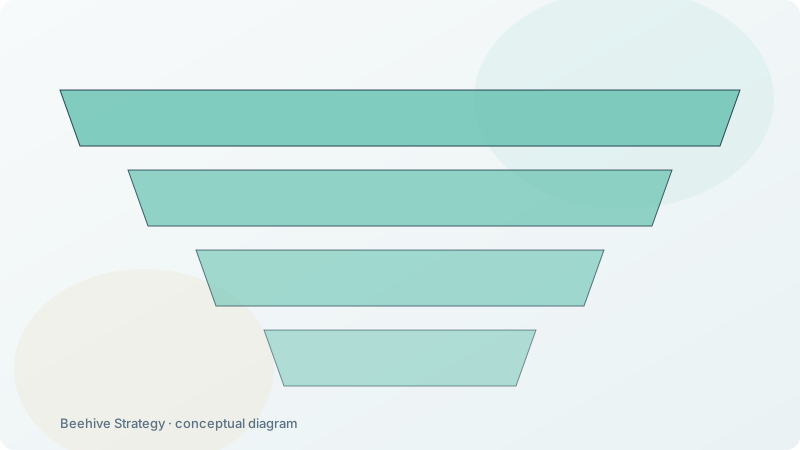
A reference architecture for agent orchestration typically layers four concerns. At the base is the event backbone itself: a partitioned, durable log that orders and stores events. Above it sit producers that emit business events and consumers, the agents, that react. A schema registry enforces contracts so a change in one producer cannot silently break a downstream agent. An observability layer records event-level lineage, confidence scores, and replays so operators can see why an agent acted as it did.
The payoff is resilience under partial failure. When one agent is slow or broken, the backlog buffers rather than cascades, and replay reconstructs exactly what an agent saw. Combined with schema governance and observability, this architecture is what lets multi-agent systems scale beyond prototypes into dependable production workflows, where a single misbehaving component degrades gracefully instead of taking the whole process down.
How Do You Test Event-Driven Agent Workflows?
Testing these systems means testing both the happy path and the disorderly one. Unit tests cover individual agent reasoning, but the interesting failures live in the seams: out-of-order events, duplicate deliveries, a producer emitting a contract-violating payload, or an agent that hangs. The reliable pattern is to record production event streams and replay them in a sandbox, injecting faults deliberately to confirm the system buffers, dead-letters, and recovers instead of corrupting state.
Because agents are non-deterministic, tests should assert on invariants rather than exact outputs: did the saga eventually reach a consistent end state, were duplicate events ignored, was a compensating event emitted when a step failed. Treating the event log as a replayable fixture turns flaky agent behaviour into a repeatable regression suite, and gives teams the confidence to deploy new agent versions without fear of silently breaking long-running workflows.
How Do You Secure Events and Agents?
Security in an event-driven agent system is about who may emit, who may consume, and what an agent may do with what it learns. Every event should carry a verifiable producer identity and a tamper-evident signature, so a compromised agent cannot forge events from another. Consumption should be scoped by fine-grained authorization, because an agent that can read every stream can exfiltrate far more than a traditional service with narrower access.
Agents also need constrained action: an agent that can only propose, not execute, external effects dramatically shrinks the blast radius of a bad inference. Pair least-privilege access with full auditability through the event log, and you get a system where a security review can reconstruct exactly which agent saw which event and took which action. That audit trail is what makes regulated or high-value agent deployments defensible to security and compliance teams.
How Do You Choose the Right Event Backbone?
Choosing the backbone is a decision about guarantees, not brand. The first question is ordering: does your agent workflow need total global order, or is per-key ordering sufficient, because the latter unlocks far more throughput. The second is durability and replay: can you reconstruct history after a failure, which is non-negotiable for agent systems that must explain their actions. The third is delivery semantics: at-least-once with idempotency is usually the pragmatic choice over exactly-once, which is often an illusion that costs dearly.
The operational fit matters as much as the feature list. A backbone your team cannot operate at 3am is the wrong backbone no matter how elegant. Favour one with mature tooling for replay, dead-letter handling, and schema registry integration, because those are exactly the capabilities agent orchestration leans on. Match the backbone's guarantees to the workflow's tolerance for disorder, and the architecture stays robust as you add agents.
Frequently Asked Questions
What is event-driven architecture and why does it matter for AI agent orchestration?
Event-driven architecture decouples agents through asynchronous events rather than direct calls, letting many autonomous agents react to the same signal without tight coupling. For multi-agent systems this prevents brittle point-to-point dependencies and lets orchestration scale as new agents subscribe to events.
How do event contracts and schema governance keep agent systems reliable?
Event contracts define the exact shape, version, and semantics of every event a producer emits. With schema governance and a registry, consumers fail fast on contract violations and changes are reviewed before deployment, which stops silent data drift from breaking downstream agents.
Why is observability different in probabilistic AI systems?
Agents make non-deterministic choices, so traditional request traces are not enough. You need event-level lineage, confidence scores, and replay of event streams to understand why an agent acted a certain way, plus alerting on drift in outcomes rather than just latency.
How do event streams connect to conversational action?
A recorded event stream becomes the audit trail and the trigger source for conversational interfaces. A user can ask a natural-language question and the system resolves it against the event log, turning raw streams into queryable, conversational business actions.