Answers in the channel
The assistant lives in WeChat, DingTalk, Feishu, Teams or your own portal. No new tab, no new login, no new habit to learn.

An assistant, not a chatbot.
Answers from your own data, with the query and source shown behind every number. It lives inside WeChat, DingTalk, Feishu, Teams or your portal — with role-based permissions carried across.
OUTCOME
A real decision shortened in the channel your team already opens.
EMPHASIS
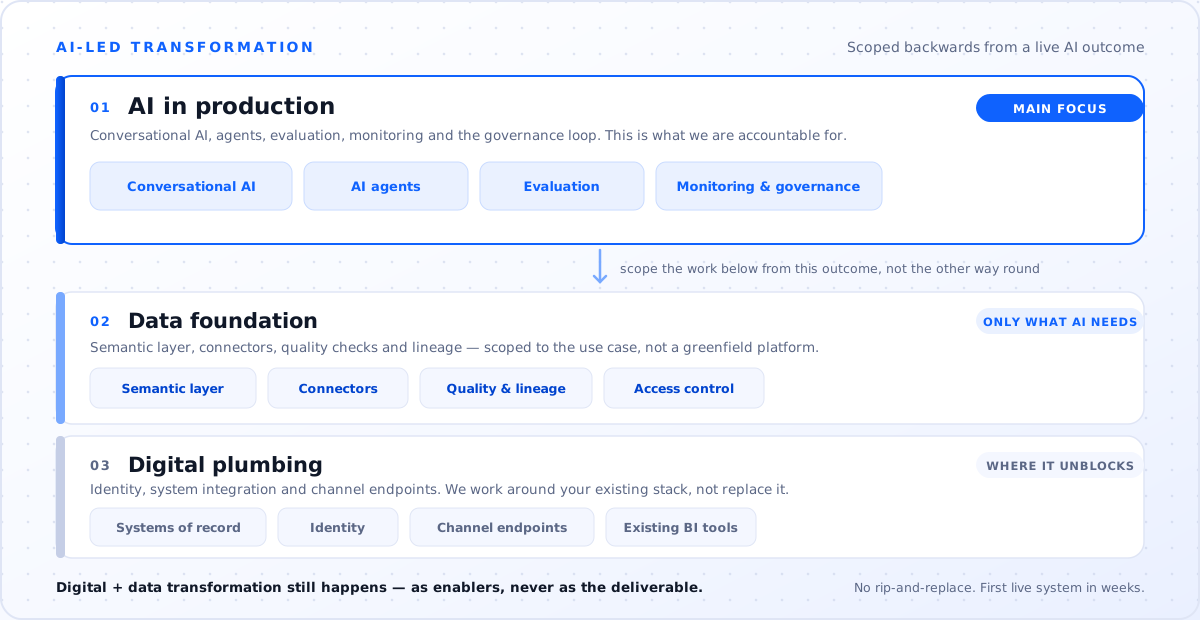
Production AI first; data scoped to the use case.
Not a chatbot, not another dashboard: a question-to-answer system wired to your governed data, with the evidence attached.
The assistant lives in WeChat, DingTalk, Feishu, Teams or your own portal. No new tab, no new login, no new habit to learn.
Each answer carries the query, the source table and the metric definition. When a figure is challenged, the evidence is already there.
Role-based access is enforced at the data layer, not the UI. Two people can ask the same question and legitimately see different answers.
We start with the single question your team chases most often, then widen coverage only after that answer is trusted.
Four roles, four questions the assistant answers from your own data — with the source attached to every figure.
Which SKUs lost margin this week, and why?
Returns the three largest margin drops with the driver — promo depth, COGS shift or mix — each linked to the source table so the buyer can act today.
Behind it: daily margin fact · SKU dimension · gross_margin_pct
What is our net cash position across entities for the next 14 days?
Returns position by entity with opening balance, inflows and outflows shown, so the treasury lead sees the shortfall before it lands.
Behind it: treasury feed · entity mapping · cash_flow_vw
Where are we at risk of stockout this week?
Returns at-risk SKUs per store with days-of-cover and supplier lead time, so the planner reorders the right lines first.
Behind it: inventory snapshot · supplier lead times · dos_forecast
Summarise this quarter’s AI readiness gaps.
Returns the ranked gap list from your last readiness audit with the owner and the recommended fix, so the board conversation starts from evidence.
Behind it: readiness audit · scorecard · gap_register
No new tab, no new login. The answer arrives where the question was asked — and the evidence travels with it.
daily_margin_fact · metric: gross_margin_pct · query: top_margin_drops(7d)Every answer is computed from your governed data and carries the query, the source table and the metric definition. When a figure is challenged, the evidence is already there — not buried in a deck.
Permissions are enforced at the data layer, so two people can ask the same question and legitimately see different answers.
The assistant is the deliverable. Data and integration work are scoped backwards from it — never the other way round.
Four steps sit between the question your team asks and an answer they can trust. Every step is visible — nothing happens inside a black box.
The question arrives in the channel your team already opens — WeChat, DingTalk, Feishu, Teams or your portal. No new tool, no new login.
→The assistant resolves the question against your governed semantic layer — the same metric definitions your reports already use, so the number means what everyone expects.
→Role-based permissions, row-level access and audit logging are applied before any figure is returned. Two people can ask the same question and legitimately see different answers.
→The reply arrives with the query, source table and metric definition attached — so it can be challenged, traced and trusted, not just read.
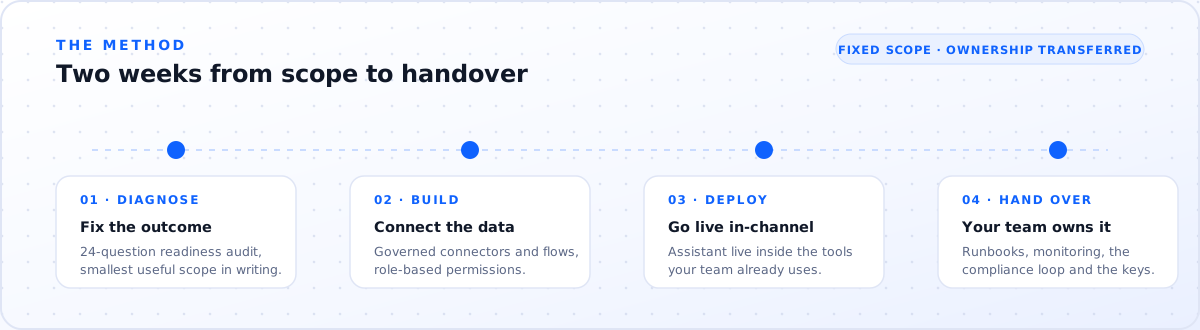
Diagnose, build, deploy, hand over. Four fixed steps, one named owner on your side, and a written definition of what “working” means before anyone writes code.
Select, sandbox and govern the agents your teams want to use. Evaluation, scoped permissions and a compliance loop travel with every deployment.
See Agentic Tools →Embedded engineers who build, deploy and hand over the system in weeks — not a slide deck and a roadmap that starts next quarter.
See FDE →Courses and in-house programmes that give your team the vocabulary to buy well and the capability to run what we build.
See Training →Start with the free audit, a course, a two-week deployment, or a full embedded programme. Every route ends at the same place: a governed AI system your own team owns.
See all services →We fix one live AI outcome first — a working assistant, an agent or an evaluation loop — and scope all data and integration work backwards from it. No platform programme is allowed to become the deliverable.
No. We connect to what you already have and add only the connectors, metric definitions and quality checks the chosen use case needs.
Most teams start with the free readiness audit, then take either a two-week deployment or a training course depending on the gap it exposes.
A chatbot answers from a script. Our assistants answer from your governed data, show the query and the source behind each number, and live inside the messaging tools your team already uses.
Yes. Delivery is IM-native: the assistant sits in the channel where the question is asked, with role-based permissions carried across.
A scoped first system is typically live in two weeks, including connectors, permissions, runbooks and handover.
No. We work around your existing stack. The assistant sits on top of current systems through a governed access layer.
An embedded engineer works inside your team to build, deploy and transfer ownership of the live system, rather than handing over a recommendations deck.
Agents can take actions, not only answer questions. Every deployment carries evaluation, scoped permissions, logging and a review loop so behaviour stays explainable.
No. Courses cover buyers, operators and executives as well as engineers, so the people approving and using AI share the same vocabulary.
Your team does. We hand over the runbooks, monitoring, source configuration and the keys; nothing depends on our continued presence.
We agree the outcome in writing before build: a question that must be answered, a decision that must shorten, or a task that must disappear. It is measured in the live channel, not in a demo.
Take the free readiness audit, or tell us the question your team keeps having to chase. We will recommend a practical starting point — no slides, just substance.