Enterprise software is undergoing a fundamental architectural shift: from applications that execute predefined workflows to systems where AI agents dynamically orchestrate tasks, make decisions, and adapt processes in real time. This shift from static workflows to agentic workflows represents the next major evolution of enterprise automation, and it is being enabled by the convergence of MCP data access, LLM reasoning capabilities, and semantic layers that provide business context.
Key Insight: By 2027, 30% of enterprise workflows will incorporate agentic elements, up from under 5% in 2025. Organizations piloting agentic workflows report 40-60% reduction in process cycle times and 35% improvement in process outcome quality by allowing AI agents to adapt steps based on real-time data.
Why Are Enterprises Moving From Static Workflows to Agent Orchestration?
Traditional enterprise workflows are static: a purchase order moves through approval, sourcing, and payment stages in a predetermined sequence, regardless of whether market conditions have changed, whether the supplier has reliability issues, or whether a better option has become available. The workflow executes as designed even when the design is no longer optimal. Agentic workflows fundamentally change this by embedding AI agents at decision points within the process, where they can evaluate current conditions, access relevant data through MCP connectors, and adapt the workflow in real time.
Consider a procurement workflow. In a static system, a purchase requisition follows a fixed path: submit, manager approve, procurement review, vendor selection, PO creation, goods receipt, invoice match, payment. An agentic procurement workflow embeds AI agents at multiple decision points. The vendor selection agent queries current pricing across approved vendors, checks supplier reliability scores, evaluates inventory levels, and recommends the optimal vendor based on current conditions — which may differ from the standard vendor. The approval agent evaluates whether the requisition aligns with budget allocation and flags exceptions for human review only when spending patterns deviate from plan.
The business impact is measurable. Organizations piloting agentic workflows in procurement report 40-60% reduction in cycle times and 25-35% cost savings through better vendor selection and dynamic pricing negotiation. The improvement comes not from automating existing steps faster but from making better decisions at each step based on current data that was previously inaccessible at the point of decision. MCP connectors are essential to this architecture because they provide the real-time, governed data access that agents need at each decision point.
What Does the Technology Stack for Agentic Workflows Look Like?
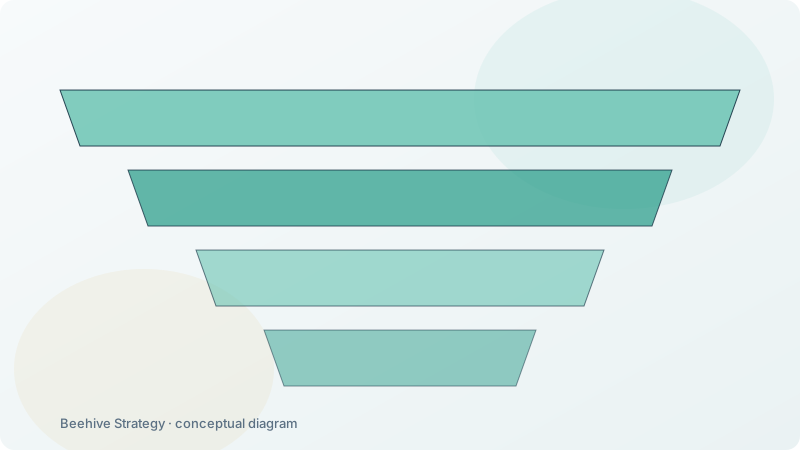
Building agentic workflows requires four technology layers working together. The agent reasoning layer uses LLMs to interpret process context, evaluate options, and make decisions. This is not about replacing human judgment but augmenting it — agents handle routine decisions that follow clear rules while escalating ambiguous or high-stakes decisions to human operators with full context about what the agent considered and why it is recommending escalation.
The data access layer uses MCP connectors to provide agents with real-time access to all relevant enterprise data. In a procurement workflow, the vendor selection agent needs access to vendor performance data, pricing databases, inventory systems, contract management systems, and potentially external market data. MCP provides the standardized integration that makes all these sources accessible without custom coding for each new workflow. The semantic layer ensures that agents use consistent business definitions — 'lead time,' 'total cost of ownership,' and 'supplier reliability score' have precise, governed meanings that the agent uses consistently across all workflow instances.
The workflow orchestration layer manages the overall process flow, tracking which agents are active, what decisions have been made, and what steps remain. This layer must support both automated agent decisions and human-in-the-loop escalation points. The observability layer monitors agent behaviour, tracking decision patterns, flagging anomalies, and maintaining audit trails. For regulated industries, this observability is essential for compliance. For all industries, it provides the feedback loop that improves agent performance over time. Beehive Strategy's platform provides the data access and semantic layers that agentic workflow systems need to make well-informed, consistent decisions.
How Do Agentic Workflows Work in Practice?
The most successful agentic workflow deployments in early 2026 share common patterns. First, they start with well-understood, high-volume processes where the decision logic is clear but the data required for optimal decisions is distributed across multiple systems. Procurement, order management, and customer onboarding are the most common starting points because the processes are well-defined, the data sources are known, and the business value of better decisions is easy to quantify.
Second, they use a 'human-in-the-loop with decreasing involvement' model. Initially, agents make recommendations that humans approve. As confidence in agent decisions builds — validated by the observability layer tracking accuracy rates — the system progressively automates more decisions, escalating only exceptions or novel situations. A financial services firm deploying agentic workflows for loan origination started with agents recommending loan terms that human underwriters approved. After three months of tracking agent recommendations against actual outcomes, the system automated 72% of routine loan decisions, reserving human review for complex cases and exceptions.
Third, they invest heavily in the semantic layer that agents use for decision-making. The quality of agent decisions is directly proportional to the quality of the business definitions in the semantic layer. An agent evaluating supplier reliability needs a clear, precise definition of what 'reliability' means in this context — on-time delivery rate, quality defect rate, communication responsiveness, and how these factors are weighted. Organizations that invested in semantic modeling before deploying agentic workflows report 30% higher agent decision accuracy compared to those that deployed agents with ad-hoc definitions.
What Are the Challenges and How Do You Mitigate Them?
Agentic workflows introduce new risks that traditional workflow systems do not face. Agent hallucination — where an AI agent makes a decision based on fabricated reasoning rather than actual data — is the most significant risk. Mitigation requires constraining agents to use only MCP-connected data sources for decision-making, never generating decisions from model knowledge alone. Every agent recommendation should include a data lineage trace showing which data sources were consulted and what values were found. The semantic layer provides an additional safeguard by ensuring that agents use validated business definitions rather than interpreting terms independently.
Agent drift — gradual degradation in decision quality over time as data patterns shift — is the second major risk. The observability layer must continuously monitor agent decision patterns against outcomes, flagging when decision accuracy degrades below thresholds. This requires a feedback loop where the outcomes of agent decisions are tracked and fed back into agent evaluation. For a procurement agent, this means tracking whether vendor recommendations actually resulted in the best outcomes — on-time delivery, quality, and total cost — and adjusting agent behavior when recommendations prove suboptimal.
The third risk is organizational resistance. Agentic workflows change how work gets done, and employees who have built expertise in the current process may perceive AI agents as threats rather than tools. Successful implementations address this through transparent communication about what agents do and do not do, involving process experts in agent design, and demonstrating that agents handle routine decisions while freeing humans for more complex, higher-value work. Organizations that invested in change management alongside agentic workflow deployment report 3x higher employee acceptance rates.
How Do You Scope an Agent Without Losing Control?
The way to give an agent autonomy without losing control is to bound it on three axes: the tools it can call, the data it can touch, and the actions it can take without human approval. A well-scoped agent might be free to retrieve data and draft a recommendation, but must hand off anything that changes a system or spends money to a human reviewer. That boundary is what keeps autonomy productive rather than dangerous.
The second practice is to make every agent action observable. Each tool call, data read, and decision should be logged with enough context to reconstruct why the agent did what it did. Observability is what allows an organisation to widen an agent's autonomy later, because the trust built on visible behaviour is the only sustainable basis for granting more.
Which Enterprise Functions Are Going Agentic First — and Why?
Agentic adoption follows a predictable selection pattern: functions where the work is digital, the rules are documented, and the cost of a bounded error is measurable go first. Customer support leads in most enterprises — an agent that triages tickets, drafts responses grounded in the knowledge base, and escalates on sentiment or confidence thresholds maps cleanly onto existing quality metrics. Sales operations follows: pipeline hygiene, CRM enrichment, quote assembly, and follow-up sequencing are high-volume, well-defined tasks where agents demonstrably reclaim selling hours. Finance operations — invoice matching, reconciliation variance triage, expense policy checks — is the third wave, with the added benefit that exceptions route naturally to humans under existing approval hierarchies.
The pattern behind the pattern: each early-adopter function already has a supervision structure. Support has QA review, sales has pipeline inspection, finance has three-way matching and audit. Agentic workflows did not create oversight in these functions; they plugged into oversight that existed, which is why their deployments survived first contact with reality. Contrast this with functions lacking supervision scaffolding — strategic planning, creative development — where enterprises rightly hesitate: not because agents cannot help, but because there is no measurement loop to distinguish a productive agent from a confidently wrong one. The scoping lesson for 2026 planning: begin where the audit trail already exists.
Sector texture matters as well. In manufacturing, agentic workflows cluster around maintenance and supply chain — agents that monitor telemetry, schedule interventions, and rebalance procurement orders against demand signals. In professional services, they cluster around evidence gathering and document assembly. In software organisations, incident response has become the canonical agentic workflow: alert triage, runbook execution, post-incident draft summaries. Note what is common across all three: the agent's output is reviewed by a human accountable for the outcome. That review loop — not the underlying model — is the actual production technology.
How Do You Measure the ROI of Agentic Workflows?
Measurement discipline separates agentic programmes that compound from those that plateau. The foundational metric is task-level deflection with quality parity: what share of a task's instances does the agent complete without human touch, at a defined quality bar? Deflection alone flatters — an agent that deflects 70% of password resets at 95% accuracy may be net-negative if the 5% errors cost more than the automation saved. Pair deflection with rework rate, escalation appropriateness (are the right cases reaching humans?), and cycle-time delta for the cases the agent handles. Enterprises mature enough to measure this way instrument tasks before deploying agents, not after.
The second measurement layer is economic. Fully loaded, an agent instance has real costs: inference and tool-call spend, evaluation infrastructure, monitoring, and the human capacity to review and improve it. The honest unit economics are cost per completed task — agent plus human oversight plus failure remediation — compared against the pre-automation baseline. Early enterprise data suggests a consistent shape: the first agents in a function are expensive per task because they carry platform and governance build costs; subsequent agents inherit the scaffolding and drop steeply. This is why the platform-versus-per-agent accounting matters in budget conversations: enterprises that expense agent platforms against the first use case conclude agents are uneconomic; those that amortise across a portfolio see the true curve.
The third layer is the one most organisations skip: option value and learning capture. Every agent interaction produces training signal — where the agent hesitated, where humans overrode it, where the knowledge base was insufficient. Enterprises that route these signals back into their semantic layer and runbooks compound their advantage; those that treat each deployment as a closed box pay full price again for the next one. A quarterly agent review that asks "what did the overrides teach us?" is, in retrospect, the highest-leverage meeting on the agentic calendar.
What Goes Wrong in Agentic Deployments — and How Do You Prevent It?
The recurring failures are organisational before they are technical. The first is scope creep by demonstration success: a scoped agent earns trust, someone extends its remit informally, and six months later an ungoverned agent is making decisions nobody authorised. Prevention is contractual: the agent's allowed actions, tools, and escalation paths are versioned artefacts, and any expansion is a reviewed change — the same discipline as production code, because that is what it is. The second failure is evaluation decay: models, prompts, and upstream data all drift, and an agent that passed its launch evaluation silently degrades. Scheduled re-evaluation against a golden task set, with published scores, keeps this visible; several enterprises now treat agent evaluation scores exactly like service-level indicators, with alerting on regression.
The third failure is the permission mismatch: the agent holds standing access that no human in the process holds — the integration account can read everything, write widely, and act continuously. The principle to enforce is least privilege with just-in-time elevation: agents request elevated access per task with logged justification, exactly as human operators do in mature environments. The fourth failure is the orphaned agent: built by an enthusiastic team, owner departs, no one updates the runbooks, and the agent keeps operating on stale assumptions. Ownership registration in the enterprise agent inventory — with a named accountable owner and a renewal review — prevents the graveyard.
Underneath all four sits the same design stance: agents are workforce, and workforce needs management systems. Onboarding (evaluation and certification), supervision (monitoring and override), performance review (quarterly scoring against task sets), and offboarding (decommissioning with audit) — the enterprises that borrowed these HR-shaped disciplines report fewer incidents and, notably, faster expansion, because trust built through management is what unlocks the next wave of delegated authority. The technology for agentic workflows is ready; the management practice is the differentiator, and it is being invented now, by the organisations deploying first and documenting what works.