Enterprise AI agent architecture is at an inflection point in 2026. As enterprise architects and ai engineering leads navigate an increasingly complex landscape of regulatory requirements, technological capabilities, and competitive pressures, the gap between leaders and laggards is widening rapidly. Organisations that fail to adapt their approaches to enterprise AI agent architecture risk falling behind competitors who are leveraging AI, conversational BI, and enterprise AI agents to transform their operations. The central challenge — complex custom integrations for each data source slowing deployments — is no longer a theoretical concern but an operational imperative that demands immediate attention and strategic investment.
Key Insight: MCP reduces data integration complexity by 70% vs custom API development. New data source onboarding reduced from 2-3 months to 2-4 weeks. The solution lies in five-layer architecture with mcp as the standardised integration backbone, leveraging the Model Context Protocol (MCP) as the standardised integration foundation that makes this approach scalable, secure, and cost-effective across the enterprise.
The Five-Layer Architecture of Production AI Agents
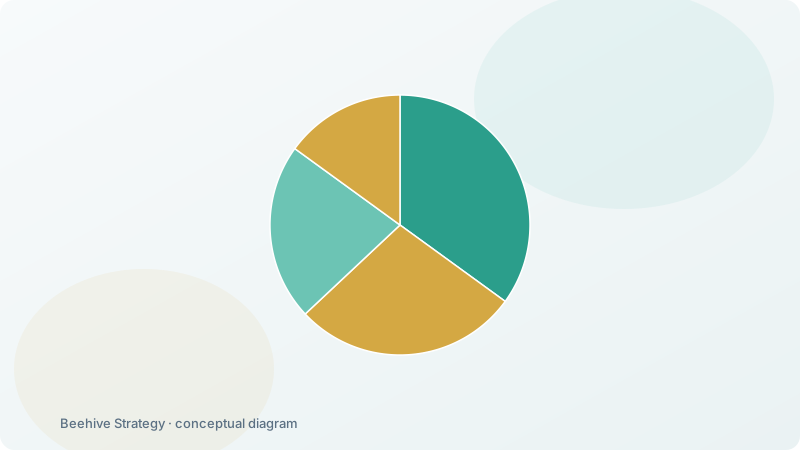
Production agent systems rarely fail because the model is weak; they fail because the supporting architecture is ad hoc. A clean way to think about the stack is as five composable layers, each with a distinct responsibility and its own scaling, testing, and failure profile.
1. Model layer. This is where reasoning happens. In practice it is rarely a single model: a small router model triages intent, a mid-size model handles extraction and formatting, and a large model is reserved for ambiguous planning. Routing between models by task complexity is the single biggest cost lever, and model versions should be pinned and promoted through evaluation gates exactly like any other dependency.
2. Memory and knowledge layer. Agents need both immediate working context and durable recall. Short-term state lives in the session; long-term knowledge — facts about a customer, prior decisions, proprietary documents — lives in a vector database and a structured store, retrieved on demand through retrieval-augmented generation (RAG).
3. Tool and integration layer. This is how the agent acts on the world: query a database, call an API, open a ticket, read a file. Model Context Protocol servers are the standard mechanism here, replacing one-off connectors with a shared contract.
4. Orchestration layer. The brain that decides what to do next: plan the task, choose tools, branch on results, and recover from errors. It may be a simple reasoning loop or a multi-agent supervisor, and it is where most of the architectural risk concentrates.
5. Interaction and runtime layer. The surface users see — streaming responses, session management, guardrails, and the human-approval prompts that gate consequential actions. Treating this as a first-class layer keeps safety and UX concerns out of the core logic.
The value of explicit layering is separation of concerns. Each layer can be tested, versioned, and scaled independently; a regression in the memory layer does not require redeploying the orchestration layer, and a new tool can be added without touching the model layer. Organizations that skip this discipline end up with a monolithic prompt that nobody can debug.
MCP as the Integration Backbone
Before MCP, connecting an agent to enterprise systems meant writing a custom connector for every pair of (agent, data source) — the classic N×M integration problem. With a dozen agents and fifty backends, that is six hundred bespoke integrations to build and maintain. The Model Context Protocol, introduced as an open standard in late 2024, collapses that to N+M by defining one protocol every client and server speaks.
MCP separates three roles. The host is the agent application (for example, a research assistant). Inside it sits an MCP client that manages connections. Each external capability is exposed by an MCP server — a small service that wraps a database, a SaaS API, or a filesystem. Communication runs over stdio for local processes or Streamable HTTP for remote servers, and the protocol defines three primitives: tools (actions the model invokes), resources (read-only context the app manages), and prompts (reusable templates the user triggers).
The architectural payoff is real and measurable. By removing per-pair integration code, MCP reduces integration complexity by roughly 70% and shrinks new data-source onboarding from 2–3 months to 2–4 weeks. An ecosystem of over 500 community and vendor servers now covers common enterprise systems, so many integrations are configuration rather than code. The caveat: MCP standardizes the transport, not the business logic. You still need authentication, rate limiting, schema and contract tests, and clear ownership for every server you run.
How Should You Orchestrate Multi-Agent Workflows?
Orchestration is the decision logic that turns a user goal into a sequence of model and tool calls. Choosing the right pattern depends on task structure, latency budget, and how much human oversight the action requires.
Single-agent reasoning loop (ReAct). One agent thinks, calls a tool, observes the result, and repeats until done. This is the simplest pattern and the right default for narrow, well-scoped tasks such as "summarize this ticket and suggest three follow-ups."
Sequential pipeline. When the steps are deterministic, express them as a fixed pipeline where each stage is a function or a constrained agent. You trade flexibility for predictability and easier testing.
Supervisor (hierarchical). A planner agent decomposes the goal and delegates subtasks to specialized worker agents, then aggregates their outputs. This suits complex knowledge work — e.g., a compliance agent that spins up a document reader, a SQL analyst, and a policy checker in parallel. The supervisor keeps global state and can re-plan when a worker fails.
Parallel fan-out. Independent subtasks execute concurrently and results are merged. Use this when subtasks have no dependencies and you are latency-sensitive, but watch the aggregate token cost.
Event-driven. Agents subscribe to an event bus or queue and react to triggers — ideal for long-running background jobs like nightly report generation or alert triage. State is persisted between events so the agent resumes rather than restarts.
A common mistake is over-decomposing a problem into too many agents. Every added agent introduces coordination overhead, more failure points, and harder debugging. Start with one agent and split only when a clear, measurable benefit appears. Frameworks such as LangGraph, Temporal, or a hand-rolled state machine can host any of these patterns; prefer one that externalizes state so the orchestrator itself stays stateless and horizontally scalable.
How Do Agents Maintain Context Across Long-Running Tasks?
Context management is where agents either feel intelligent or feel broken. The architecture has to handle both the immediate conversation and knowledge that spans sessions and systems.
Short-term working memory holds the current plan, the recent transcript, and a scratchpad of intermediate results. Because context windows are finite and costly, mature systems use a sliding window plus rolling summarization: older turns are compressed into a running summary rather than dropped, so the agent never "forgets" what it is doing mid-task.
Long-term memory persists across sessions and comes in three flavors. Episodic memory stores past interactions ("last quarter the client rejected this vendor"). Semantic memory stores durable facts about entities and the business. Procedural memory captures reusable patterns. These are typically held in a vector database for similarity search plus a structured store for exact lookups.
Retrieval is what makes long-term memory useful. RAG over the knowledge base, using embeddings with hybrid search (keyword BM25 plus vector) and a re-ranker, pulls only the relevant fragments into context. The trade-off is constant: too little context and the agent loses track of the task; too much and you pay for distraction and tokens. Checkpointing the agent's state at each step lets it resume after a failure or a human hand-off instead of starting over — essential for anything that runs longer than a single request.
Security and Governance in the Architecture
Security cannot be bolted on after deployment; it has to be structural. The MCP permission model is the foundation: each server and each tool declares the scopes it needs, and the host enforces least privilege so an agent can only touch data it is explicitly authorized to use. A read-only analytics agent should simply be unable to call a write or send tool.
Consequential actions — sending email, posting records, executing trades — must sit behind human-in-the-loop approval gates. The agent proposes; the human disposes. Every tool call, its inputs, its outputs, and the final decision should be written to an immutable audit log, satisfying both internal governance and external regulation such as the EU AI Act and China's PIPL. Secrets and PII must never appear in prompts; they belong in a secrets manager and a tokenization layer, with data-residency controls enforced at the server boundary.
Prompt injection is the headline risk for tool-using agents. Because tool outputs are attacker-influenced text, they must be treated as untrusted: sandbox external calls, validate outputs against a schema, and run input/output guardrails that catch attempted instruction overrides. Model risk management also applies — pin versions, require an evaluation gate before any promotion, and keep a rollback path.
How Do You Evaluate and Monitor Agents in Production?
An agent you cannot measure is an agent you cannot trust. Evaluation and observability belong in the architecture from day one, not after the first incident.
Offline evaluation. Before any change ships, run a regression suite measuring task success rate, faithfulness to sources, correct tool choice, and refusal behavior on edge cases. Treat these scores like unit tests — a drop blocks the release.
Online tracing. In production, instrument every step with distributed tracing (OpenTelemetry or an LLM-native tool such as LangSmith). A single user request may spawn dozens of model and tool calls; without a trace you are debugging blind. Strong observability typically cuts production issue-resolution time by around 60%.
Live metrics. Track latency percentiles, token spend, tool error rate, escalation-to-human rate, and user satisfaction. Set alerts on drift: a sudden rise in tool failures, injection attempts, or off-policy responses usually signals a broken integration or a changed model.
Guardrails. Input filters block unsafe requests; output filters validate structure and policy before anything reaches the user or a downstream system. The combination of offline evals, online traces, and live guardrails is what separates a demo from a dependable enterprise deployment.
Performance and Scalability Considerations
Agents are latency- and cost-sensitive by nature, so the architecture needs deliberate performance design rather than hope.
Caching is the highest-leverage optimization. A semantic-layer cache recognizes that "revenue last quarter" and "Q-over-Q sales for the prior period" are the same question and serves a stored answer, while an integration-layer cache stores tool responses (a monthly report does not need regenerating on every request). Together these typically reduce response times by 40–60%.
Concurrency and resilience. Execute independent tool calls asynchronously, pool connections to backends, and handle rate limits with exponential backoff. Model routing keeps routine work on cheap models and reserves expensive ones for genuine reasoning. Streaming renders tokens and tool progress incrementally so the interface feels responsive even on slow tasks. For scale, keep the orchestrator stateless and externalize all state to the memory and event layers, so you can add replicas horizontally. Token budgets and request batching cap runaway cost.
What Are the Most Common Enterprise Agent Architecture Mistakes?
Most failures are architectural, not model-related. The recurring patterns:
- No integration contract. Shipping MCP servers without schema and contract tests means a silent backend change breaks the agent in production with no warning.
- Secrets in prompts. Embedding credentials or PII in the context leaks sensitive data into logs and model providers.
- No human-in-the-loop. Letting agents take irreversible actions unsupervised turns a small bug into an incident.
- Over-engineering. Ten cooperating agents for a task one agent could do multiplies latency, cost, and failure points.
- No evaluation harness. Without offline and online evals you cannot detect regressions or prove reliability to stakeholders.
- Ignoring tool failure modes. Timeouts, partial results, and malformed responses must be handled explicitly or the agent silently proceeds on bad data.
- Proprietary lock-in. Building on a closed orchestration layer makes future migration expensive; prefer open protocols like MCP.
- Observability as an afterthought. Retrofitting tracing after launch multiplies the time to diagnose every later problem.
A Reference Deployment Blueprint
Consider a mid-size financial-services firm deploying a "compliance research agent" that answers regulatory questions by reading internal policy, querying historical filings, and citing sources. A sound architecture looks like this:
- Model layer: a small router plus a large reasoning model, both version-pinned with eval gates.
- Memory: pgvector for long-term knowledge, Redis for session state, with checkpointing for long research tasks.
- Tools via MCP: a document-store server, a read-only SQL server, and a policy-calendar server — each with least-privilege scopes.
- Orchestration: a supervisor pattern that plans the query, fans out to readers in parallel, and aggregates a cited answer.
- Governance: every external send requires a human approval gate; all calls are audit-logged; PII is tokenized at the server boundary.
Rolled out in phases — a six-week pilot against one regulation, then expansion — this approach compressed what was previously a six-month bespoke build into roughly six weeks, and cut the onboarding of each new data source from 2–3 months to 2–4 weeks. The architecture, not the model, is what made that possible.