Converged BI, AI, and process automation — intelligent process automation (IPA) — is the practical endpoint of enterprise digitization, and the highest-leverage first step is a single high-value process where visibility, reasoning, and action are implemented together rather than stitched together later. The convergence thesis is simple: dashboards tell you what happened, models tell you what will happen, and automation makes something happen. Kept separate, each is an island; combined, they form a closed loop that senses, analyzes, decides, and acts.
The timing is right because the raw material is already there. McKinsey has estimated that roughly 30% of work activities in about 60% of occupations could be automated with current technology, and Gartner has projected that by 2025, 50% of analytical queries will be generated via search, natural language processing, or voice. IDC has forecast that the intelligent process automation software market will reach $15.8 billion by 2025. Enterprises are no longer choosing whether to combine these capabilities, but how quickly they can do it without rebuilding their data stack in the process.
Why Move From Separate Tools to Integrated Workflows?
Enterprise technology has historically deployed BI, AI, and process automation as separate capabilities. BI analyzes data and produces insights. AI provides reasoning and prediction. RPA executes repetitive tasks. Each delivers value independently, but the gaps between them create friction. BI identifies a problem but requires a human to initiate the response. AI predicts an issue but has no mechanism to act on the prediction. RPA automates tasks but executes them blindly, without data-driven intelligence. Convergence eliminates these gaps by embedding analysis, decision, and action in a single workflow with minimal human intervention.
Consider an order-to-cash process. In the traditional approach, a BI dashboard shows that orders are delayed, a human notices, investigates the cause, and initiates corrective action. In the converged approach, the system monitors orders in real time, predicts which orders are at risk of delay, assesses the business impact of each potential delay against customer priority and revenue, and triggers automated expediting for high-priority orders while alerting a human only for the cases that require judgment. Teams that have deployed converged order management report cycle time reductions of around 50% and on-time delivery improvements of roughly a third compared with separate tools — because the handoffs that used to wait for a person now happen in milliseconds.
Why Are Separate BI, AI, and RPA Tools No Longer Enough?
Because handoffs are where value leaks. Every gap between tools is a human waiting, a context switch, or a decision deferred — and each leak is multiplied across every transaction the process handles. Separate tools also disagree about definitions: the BI team's "on-time delivery" may not match the RPA team's trigger, and the AI model may be trained on a version of the data that no longer exists. The failures of disconnected tooling fall into three predictable patterns:
- Insight without action: BI surfaces the problem, but nothing is wired to respond, so the insight decays into a slide.
- Prediction without execution: AI forecasts the issue, but there is no mechanism to act, so the prediction becomes a report card instead of a lever.
- Automation without intelligence: RPA executes the steps, but without data context it automates yesterday's process — errors included.
Converged workflows close all three gaps at once, which is why they change not just efficiency but the nature of the work: humans move from executing transactions to handling the exceptions that genuinely need judgment, and the process itself learns from every cycle.
What Does the Convergence Architecture Look Like?
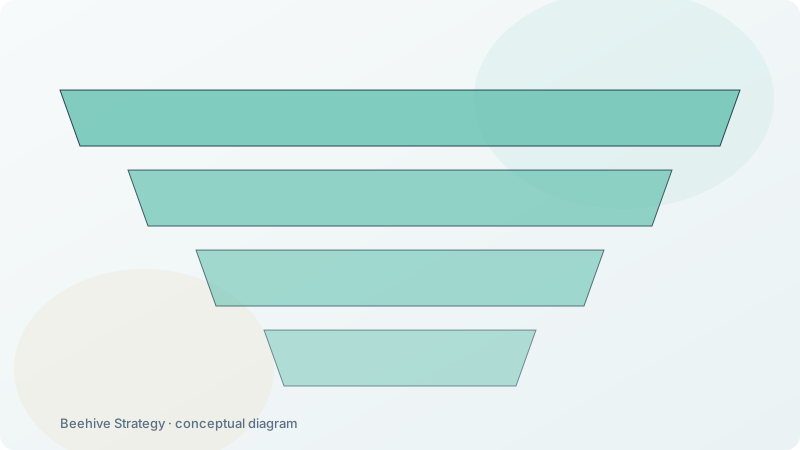
The architecture for converged BI-AI-process automation has five layers. The data access layer uses governed connectors to provide real-time access to all relevant enterprise data — ERP for orders and financials, CRM for customer data, SCM for supply chain status, and operational systems for process state. The analytics layer monitors process performance in real time, identifying anomalies and trends. The AI reasoning layer evaluates situations, makes recommendations, and decides when to act automatically and when to escalate. The automation layer executes actions — creating orders, sending notifications, adjusting schedules, triggering workflows — through integration with enterprise systems.
The orchestration layer manages the end-to-end process flow, tracking state, managing handoffs between AI and human actors, and enforcing compliance. Running through all of this is the semantic layer: the single source of truth for what business terms mean, ensuring that the BI analysis, the AI reasoning, and the automation rules all use the same metric definitions. Without the semantic layer, the different layers would compute on inconsistent definitions, recreating the misalignment that convergence is meant to eliminate.
Which Convergence Use Cases Deliver the Most Value?
Three use cases deliver the highest value from convergence. First, intelligent order management: AI monitors orders, predicts delays, assesses customer impact, and automatically initiates expediting for high-priority orders while routing the rest through standard processing — with manufacturers reporting order cycle time reductions of around 50% and on-time delivery improvements of about 30%. Second, automated financial close: AI monitors close progress, identifies reconciliation issues, resolves straightforward discrepancies automatically, and escalates complex cases to accountants with full context — with finance teams reporting close cycle time reductions of about 40% and fewer close-related errors.
Third, proactive customer service: AI monitors customer interactions, predicts churn risk, analyzes usage patterns, and triggers retention actions such as personalized offers and account reviews for at-risk customers — with customer service teams reporting churn reductions of around 20% and materially higher satisfaction. In all three, the semantic layer is the difference between a demo and a durable deployment: consistent definitions are what let the same numbers drive both the dashboard and the automated action.
What Role Does the Semantic Layer Play in Convergence?
The semantic layer is the convergence architecture's linchpin. It defines business concepts once — revenue, on-time delivery, customer priority — and exposes those definitions to every layer, so that the AI model's trigger, the BI metric, and the automation rule can never disagree. It also acts as the governance boundary: access policies, calculation rules, and audit trails live in one place instead of being scattered across dashboards, notebooks, and scripts. When a finance team asks why the dashboard and the automation disagree, the answer should be "they can't" — that is the semantic layer working.
In practice, this means convergence projects should start with the semantics, not the automation. Define the process metrics, wire them to a governed data foundation, and only then add AI reasoning and automated actions on top. Teams that reverse the order — automating first, standardizing definitions later — spend their integration budget reconciling the very inconsistencies they set out to remove.
How Do You Implement Convergence?
Organizations should implement converged workflows by selecting a single, high-value process and implementing all three capabilities in an integrated fashion, rather than deploying each separately and attempting to integrate afterwards. The recommended sequence is: first build the governed data foundation and semantic layer for the selected process; then add real-time BI monitoring; then add AI reasoning and prediction; and finally add automated actions. Each layer builds on the previous one, and the integration is designed in rather than bolted on. Organizations following this sequence report integration costs around 60% lower than those that deploy BI, AI, and automation separately and integrate afterwards.
Two practical accelerators make the approach cheaper still. First, use chat-native surfaces: a conversational BI interface inside Teams, Slack, or the intranet means the analytics layer is adopted without training or new logins. Second, use managed services: a conversational BI deployment over existing data, with the semantic layer and connectors included, can be live in about two weeks without rebuilding the warehouse. That is the fastest possible route from convergence as a concept to convergence as a working, measurable process.
Where Do BI, AI, and Automation Overlap Today?
The three used to live in separate stacks: BI reported the past, AI predicted the future, automation acted on rules. They now meet at the same data and the same decisions. A single pipeline can describe what happened (BI), forecast what will (AI), and trigger the response (automation) without a human copying numbers between tools. The overlap is where value compounds, because the insight and the action share one trusted source instead of three that drift apart.
The risk in the overlap is ownership. When a forecast automatically launches a workflow, who governs the threshold, and who is accountable when it is wrong? Convergence forces the three disciplines to agree on data definitions, on what 'good' looks like, and on where a human must stay in the loop. The teams that name that ownership early turn convergence into speed; the ones that don't get a faster way to make coordinated mistakes.
How Should Teams Sequence a Convergence Roadmap?
Sequence by decision, not by technology. Choose a workflow where a better forecast would change an action today — inventory replenishment, lead routing, exception handling — and connect the three layers only for that case. Prove the loop, measure the cycle-time gain, then replicate the pattern to the next workflow. A roadmap organized around decisions keeps each step shippable and keeps the BI, AI, and automation owners aligned on the same outcome instead of building parallel platforms that never meet.
Mini Case Study: Converged Working‑Capital Optimisation in a Global Manufacturer
A multinational consumer‑goods producer with operations in 30 countries faced persistent cash‑conversion‑cycle (CCC) drag. Finance teams relied on monthly BI dashboards to spot rising days‑sales‑outstanding (DSO), while a separate AI model predicted payment‑delay risk based on historic invoicing patterns. RPA bots then issued dunning emails, but without real‑time context they often contacted customers who had already settled, creating friction and eroding trust.
The organisation launched a converged pilot on its European order‑to‑cash stream, integrating three layers:
- Data foundation: A unified semantic layer exposed canonical tables for invoices, payments, credit limits, and customer tier. All downstream consumers read from the same virtual view, eliminating definition mismatches.
- Analytics engine: A streaming BI service (Power BI Embedded) calculated live DSO per region and fed the metric into a reinforcement‑learning model hosted on Azure Machine Learning. The model output a “risk score” and a recommended action (escalate, offer early‑payment discount, or hold).
- Action orchestrator: An IPA platform (UiPath Automation Cloud) consumed the risk score via a REST API. For scores > 0.8 it triggered an automated early‑payment‑discount offer through the ERP; for scores 0.5‑0.8 it created a high‑priority task in the collections work‑queue; for scores < 0.5 it logged the event for later review.
Within eight weeks the pilot delivered:
- DSO reduced from 48 days to 34 days (‑29 %).
- Early‑payment‑discount uptake rose from 12 % to 38 %, cutting financing costs by £1.4 m annually.
- Manual dunning effort fell by 62 %, allowing collectors to focus on the top 5 % of high‑risk accounts that required judgement.
- Model accuracy improved continuously: after each collection cycle the outcome (paid, delayed, disputed) was fed back as a label, raising the AUC from 0.71 to 0.84 in six weeks.
Key take‑aways for other enterprises:
“Convergence is not a technology project; it is a workflow redesign that forces data, insight, and execution to share a single heartbeat.”
When the semantic layer, analytic model, and automation engine are tightly coupled, the feedback loop becomes self‑correcting, turning a periodic reporting exercise into a continuously optimising cash‑flow engine.
Implementation Playbook: Step‑by‑Step Checklist for Launching a Converged BI‑AI‑Automation Pilot
Below is a practical, phase‑gated checklist that translates the convergence thesis into actionable work‑streams. Each phase includes deliverables, owners, and typical duration for a mid‑size enterprise (≈ 500 employees).
| Phase | Objective | Key Activities | Owner(s) | Typical Duration |
|---|---|---|---|---|
| 0 – Sponsorship & Scope | Secure executive backing and define a high‑impact, bounded process. |
|
CIO / CDO + Business Unit Lead | 1‑2 weeks |
| 1 – Data & Semantic Layer Preparation | Create a trusted, reusable view of the data needed for insight and action. |
|
Data Engineering Team | 3‑4 weeks |
| 2 – Analytic Model Development | Build a predictive/prescriptive model that consumes the semantic layer and outputs actionable recommendations. |
|
Data Science / ML Engineering | 4‑5 weeks |
| 3 – Automation Orchestration Design | Define the decision‑to‑action mapping and build the IPA workflow. |
|
RPA / Process Automation Lead | 3‑4 weeks |
| 4 – Integration & Testing | Wire the three layers together and validate end‑to‑end behaviour. |
|
Integration Engineer + QA Lead | 2‑3 weeks |
| 5 – Pilot Execution & Monitoring | Run the converged workflow in production on a limited scope and measure impact. |
|
Business Process Owner + Analytics Lead | 6‑8 weeks |
| 6 – Scale‑Out & Governance | Expand coverage, embed governance, and institutionalise the converged approach. |
|
CoE Lead + Enterprise Architect | Ongoing (quarterly reviews) |
Following this checklist helps avoid the common pitfall of treating BI, AI, and automation as separate “plug‑ins” and instead delivers a truly closed‑loop system where each cycle improves the next.
What to Watch in the Next 12–18 Months: Emerging Trends Shaping Convergence
The convergence of BI, AI, and process automation is moving from a tactical optimisation to a strategic capability that reshapes operating models. Below are the developments most likely to influence enterprise roadmaps over the coming year.
- Generative‑AI‑augmented semantic layers: Large language models (LLMs) are being layered on top of semantic catalogues to enable natural‑language data discovery and auto‑generation of business definitions. Expect vendors to expose “semantic‑prompt” interfaces that let analysts ask “Show me the margin trend for premium products in EMEA” and receive a ready‑to‑use dataset, reducing the time spent on data wrangling by up to 40 %.
- Edge‑enabled intelligent process automation: As IoT sensor data proliferates, IPA platforms are pushing decision logic to the edge (e.g., on‑premise gateways or Azure IoT Edge). This allows real‑time anomaly detection and immediate actuation (e.g., adjusting a conveyor speed) without latency‑inducing round‑trips to the cloud, a critical advantage for high‑frequency manufacturing and logistics.
- Outcome‑based automation contracts: Procurement teams are shifting from licence‑based to outcome‑based pricing models for AI and automation services. Suppliers now guarantee a defined KPI improvement (e.g., “reduce DSO by 15 % or pay a penalty”), aligning incentives and accelerating adoption of converged solutions.
- Regulatory‑ready model governance: With the EU AI Act entering force in 2025, organisations must maintain auditable model lineage, bias‑testing records, and human‑oversight logs. Convergence architectures that embed these artefacts directly into the automation workflow (e.g., tamper‑proof blockchain‑style logs) will become a differentiator for companies operating in regulated sectors.
- Low‑code convergence studios: The next generation of IPA platforms is unifying low‑code UI builders, model‑training wizards, and data‑mapping tools within a single studio. This reduces the need for specialised “data‑engineer‑AI‑RPA” triads and empowers citizen developers to assemble end‑to‑end intelligent flows, expanding the pool of contributors beyond the traditional centre of excellence.
- Federated learning for cross‑organisation insights: In supply‑chain consortia, firms are experimenting with federated learning to train shared demand‑forecasting models without exposing proprietary data. When combined with automated replenishment workflows, this creates a network‑wide convergence that can smooth bullwhip effects while preserving data sovereignty.
Staying ahead of these trends requires a two‑pronged approach: (1) invest in a flexible, API‑first data and model foundation that can swallow new AI capabilities as they emerge, and (2) cultivate a culture of continuous learning where process owners, data scientists, and automation engineers regularly cross‑train. Enterprises that treat convergence as a living capability — rather than a one‑off project — will be best positioned to turn data into decisive, automated action at scale.
Common Pitfalls and How to Avoid Them
Even with a clear convergence vision, organisations often stumble on predictable obstacles that erode the promised gains. Recognising these early and embedding safeguards into the roadmap can keep the programme on track.
| Pitfall | Mitigation |
|---|---|
| Data silos re‑emerge after initial integration | Establish a governed semantic layer that is version‑controlled and mandated as the single source of truth for all downstream models and bots. |
| Over‑automation of low‑value tasks | Apply a value‑effort matrix before scripting RPA; prioritise use cases where decision intelligence materially changes outcomes. |
| Model drift unnoticed in production loops | Implement continuous monitoring with automated retraining triggers and audit trails that feed back into the semantic layer. |
| Skill gaps between analytics, data engineering and automation teams | Create cross‑functional “convergence squads” with shared OKRs and rotational upskilling in ML ops, process design and data modelling. |
| Change resistance from business users fearing loss of control | Run transparent pilot showcases, expose the decision logic in plain language, and embed a human‑in‑the‑loop escalation path for exceptions. |
Measuring ROI and Business Impact of Converged Solutions
To justify continued investment, leaders must translate technical convergence into concrete financial and operational metrics. The following indicators have proven effective across industries.
- Cycle‑time reduction: Measure end‑to‑end process latency before and after convergence; typical gains range from 30 % to 60 % for high‑volume workflows.
- Decision latency: Track the time from data event to automated action; converged architectures aim for sub‑second response versus minutes‑to‑hours in siloed setups.
- Exception rate: Monitor the proportion of transactions requiring human judgement; a declining exception rate signals higher straight‑through processing.
- Cost per transaction: Compute total labour, infrastructure and licence costs divided by volume; convergence often cuts this metric by 20 %‑40 % through reduced rework.
- Revenue uplift or leakage avoidance: For use cases such as dynamic pricing or fraud detection, quantify incremental margin or prevented loss attributable to the closed‑loop system.
- Employee satisfaction: Survey staff on shift from repetitive tasks to higher‑value analysis; improved scores correlate with lower turnover and better adoption.
Establish a baseline, set quarterly targets, and embed these KPIs into the convergence programme’s governance dashboard.
Mini Case Study: Real‑Time Fraud Detection in a Global Bank
A multinational retail bank sought to reduce false‑positive fraud alerts that were overwhelming its investigation team and eroding customer experience. By converging BI, AI and robotic process automation within a single event‑driven workflow, the bank achieved a step change in detection accuracy and response speed.
“The converged pipeline cut our alert‑to‑action time from 45 minutes to under 8 seconds, while lifting true‑positive rates by 22 % and cutting operational costs by £3.4 million annually.”
— Head of Financial Crime Operations, Global Retail Bank
The architecture began with a unified semantic layer that normalised transaction metadata, device fingerprints and behavioural scores. A streaming AI model generated a risk probability in real time; a rules‑engine overlay applied policy thresholds, and an RPA bot instantly either blocked the transaction, triggered step‑up authentication, or logged the event for analyst review. Human investigators only intervened on the top 5 % of highest‑risk cases, focusing on complex fraud patterns rather than routine noise.
Results after six months included a 38 % reduction in manual review workload, a 15 % increase in blocked fraudulent attempts, and a measurable improvement in Net Promoter Score due to fewer legitimate declines. The case illustrates how closing the sense‑analyse‑act loop transforms fraud prevention from a reactive cost centre into a proactive, profit‑protecting capability.