The short answer: in 2026 the AI moat is no longer the model — it is the proprietary data, the embedded workflows, and the compounding feedback loops built around them. Foundation models have become increasingly commoditised, and any competitor can license the same frontier capabilities. What your competitors cannot copy is the operational advantage you build on top of them.
This is one of the most important shifts in AI Strategy today, because it determines where enterprise investment should go. Money spent chasing marginally better models is money that could have built defensible data assets, workflow integrations, and measurement loops.
Why Does This Matter for Enterprise AI?
The economics of models have inverted. Frontier model capabilities have advanced rapidly while inference costs have fallen dramatically — industry estimates point to declines of more than 90% in the cost of generating a token between 2023 and 2025, and the trend shows no sign of stopping. Gartner now expects that by 2026, more than 80% of enterprises will have used generative AI application programming interfaces in production. When everyone has access to the same models at falling prices, model quality stops being a differentiator and becomes a commodity input — like cloud compute before it.
The value, meanwhile, sits in the parts of the system that are unique to your organisation. McKinsey's analysis of generative AI use cases has consistently found that the majority of the value comes not from the model itself but from embedding the capability into workflows and surrounding it with proprietary data. Companies that combine proprietary data with AI report meaningfully higher returns on their AI investments — frequently 2–3x the returns of those that deploy generic models against generic data.
That is why the moat conversation matters at board level. An AI strategy built on model access alone is a cost centre with no compounding advantage. An AI strategy built on data and workflow is an asset that gets more valuable every quarter, because each interaction produces new data, new corrections, and new learning that no competitor can replicate.
The dynamic is visible in every industry where AI has moved from pilots to operations. Competitors can copy a feature in weeks, but they cannot copy a decade of customer interaction data, a decade of pricing and operational history, or the workflow habits your teams have built around an embedded system. That is why the moat conversation belongs at the level of data strategy and operating model, not model selection — and why enterprises that delay on data foundation find every AI advantage they try to build slips away to faster-moving rivals.
What Common Challenges Should You Expect?
The first challenge is competing on the wrong axis. Teams spend quarters fine-tuning models or chasing benchmarks that their customers never observe, while ignoring the data and workflow advantages that are actually defensible. The second is failing to capture data exhaust — the by-product of every AI interaction. If your system answers a question and nobody records whether the answer was accepted, corrected, or ignored, you are burning your most valuable asset: the feedback signal that makes the system better than any generic alternative.
The third challenge is workflow shallowness. A chatbot bolted onto a website is easy to copy; an AI that sits inside the order-to-cash process, checks pricing rules, surfaces margin exceptions, and learns from every approval is not. Many enterprises stop at the shallow version because it is fast to demo, and then wonder why their moat evaporated within a quarter of a competitor releasing something similar.
The fourth challenge is organisational: data lives in silos, ownership is unclear, and governance is either absent or so heavy that nothing ships. Without a shared, governed data foundation, the proprietary-data advantage that should be the moat never materialises. Finally, there is the measurement gap — most teams cannot quantify whether their AI investment is compounding, because they have no baseline for decision speed, error rates, or cost per decision before and after.
How Do You Get Started?
Start by inventorying your genuinely proprietary assets: customer interaction data, operational telemetry, pricing and margin history, product usage signals, and the accumulated judgement of your experts encoded in decisions and documents. Rank them by two criteria — how valuable they are in AI applications and how hard they would be for a competitor to replicate. That ranking is your moat map, and it should drive the investment order.
Then pick one high-value workflow where the data already exists and the decision is frequent enough to generate feedback quickly. Embed the AI into that workflow end to end, instrument every answer with accept/correct/ignore signals, and close the loop so corrections improve the system. This is the compounding engine: data in, better decisions out, more data back in.
Finally, measure like a portfolio, not a project. Track time-to-decision, error rates, cost per decision, and the growth of the proprietary dataset for each use case. Beehive Strategy helps enterprises run exactly this playbook — mapping proprietary data assets, embedding governed conversational AI into core workflows, and standing up the feedback loops and metrics that turn an AI pilot into a widening advantage.
A final point on sequencing: resist the urge to build the moat everywhere at once. One workflow, one dataset, one embedded system, operated with full feedback and measurement, is worth more than five half-integrated initiatives. The compounding effect needs a closed loop to feed on; spreading the same resources across many loops starves them all. Depth first, breadth later — that is the pattern the durable-moat leaders follow.
What actually constitutes a durable AI moat in 2026?
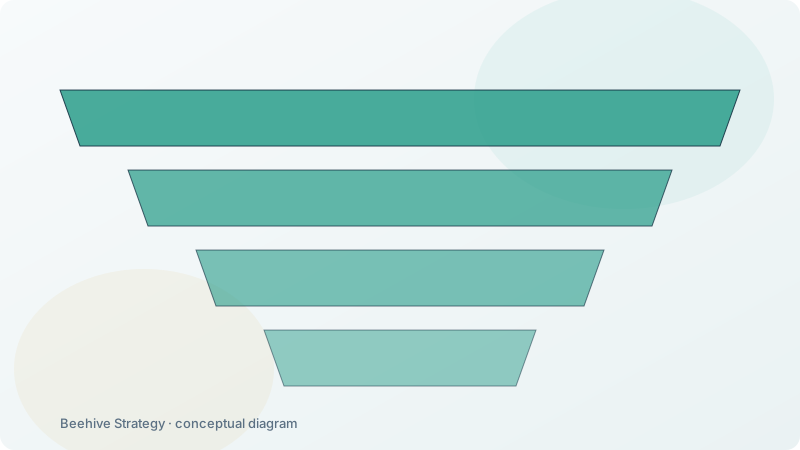
A durable moat in 2026 is a combination of four compounding assets, in order of importance. First, proprietary data that accumulates with every interaction and is governed well enough to use safely. Second, embedded workflows that make the AI part of how the business operates — not a destination users must remember to visit. Third, feedback loops that convert every use into improvement, which is what separates a capability that gets better from one that degrades. Fourth, switching costs: over time, the system becomes entangled with operating processes in ways that make replacement disruptive, not just inconvenient.
Notice what is not on the list: the model. Model selection is a procurement decision, not a moat. The organisations that treat it as such — choosing models pragmatically and investing the saved budget in data, workflow, and feedback — are the ones whose AI advantage widens year over year. Those that treat the model as the product find their lead shrinking with every model release.
The test for leadership is simple: if a competitor licensed the exact same models tomorrow, how much of your advantage would remain? If the answer is "very little," the investment is in the wrong place. If the answer is "most of it," because your data, workflows, and feedback loops are the product — you have built the only kind of AI moat that survives contact with the market.
One clarification prevents a common mistake: proprietary data alone is not a moat if it is unused or ungoverned. Data that sits in silos, undocumented and unowned, is a liability — it cannot be used in AI, it creates compliance risk, and it erodes trust when someone tries to use it. The moat forms at the intersection of data, governance, and workflow: governed data that can be legally used, embedded in workflows that generate feedback, and measured in a way that proves value. Enterprises should assess themselves against all three conditions, not just the size of their data assets.
Which Feedback Loops Actually Compound?
Not every feedback loop is a moat. Most are just logging. A loop compounds only when each cycle makes the next cycle's output better for the next user, and when the resulting asset cannot be bought.
Three loops meet that test in practice. The correction loop: users accept, edit, or reject AI output, and those corrections are captured as structured signal rather than discarded. A support organisation that captures which generated answers agents edited, and feeds the edit back into retrieval and prompt selection, improves its deflection rate every month while a competitor starting from the same base model does not. The asset is not the model — it is the accumulated record of what "right" looks like in your domain.
The outcome loop: the business result of an AI-assisted decision flows back into the system that made it. Underwriting, pricing, inventory allocation, and maintenance scheduling all generate this naturally. The lender that sees which AI-assisted approvals actually performed, and retrains on realised outcomes rather than proxy labels, pulls steadily ahead of one that only measures model accuracy offline.
The workflow-embedding loop: the more decisions the system touches, the more context it accumulates, and the harder it becomes to remove. This is the least glamorous and the most durable of the three. Once an operations team runs its daily planning through one interface, switching costs are organisational rather than technical — and organisational switching costs are what incumbents underestimate and challengers overestimate.
The test for whether a loop is real: pick a period twelve months ago and show that the same input now produces a measurably better output. If you cannot demonstrate that, you have instrumentation, not a moat.
How Do You Measure Whether Your AI Moat Is Widening?
"We have proprietary data" is not a measurement. Four indicators tell you whether the advantage is compounding or eroding, and all four can be tracked from systems you already operate.
Data asset growth, adjusted for usability. Raw volume is a vanity metric. Measure the volume of data that is governed, labelled where labels matter, and actually reachable by a production system. If governed data is growing slower than raw data, the moat is filling with silt.
Outcome gap versus a generic baseline. Run a periodic benchmark: your production system against an off-the-shelf model with no proprietary context, on the same live tasks. The gap is your moat, expressed in the unit the business cares about — accuracy, deflection rate, approval rate at constant loss, or cycle time. Track it quarterly. A widening gap means the system is compounding; a narrowing one means a competitor with a better base model is catching up and your data is not doing enough work.
Switching cost. How many workflows, integrations, and downstream decisions depend on the system? Count them, and count how many would break if the system were replaced next quarter. This is the defensive half of the moat and the part that shows up in renewal conversations.
Unit economics trend. Cost per decision served should fall over time even as volume grows, because the shared data and semantic layer amortises. If unit cost is flat while volume grows, you are renting capability rather than building an asset — and whatever advantage you have is available to anyone with the same budget.
Taken together, these four move the moat conversation from a strategy discussion to a quarterly dashboard. That is the point: moats that are not measured tend to be moats that were never built.
What Does a Durable AI Moat Look Like in Practice?
The abstraction gets clearer with two concrete cases.
Industrial maintenance. A manufacturer with fifteen years of sensor history, maintenance logs, and failure outcomes builds a model that predicts bearing failure six weeks out. The model itself is replicable — any competitor can train one. What is not replicable is the outcome data: fifteen years of what actually happened after each prediction, including the false positives that turned out to be something else. Each maintenance cycle adds ground truth, the model improves, and the downtime reduction compounds. A competitor entering the market in 2026 starts with zero outcome history, and no amount of model spending closes that gap quickly.
Commercial lending. A lender that has underwritten a specific segment for a decade holds approved-and-declined records, repayment performance, and the macro conditions that applied. Combined with cash-flow data, this supports approvals the bureaus cannot. The moat is not the credit model; it is the combination of exclusive performance data, a workflow that underwriters actually use, and the regulatory track record that lets the lender deploy it. A challenger with a better algorithm and no performance history is still guessing.
Both cases share the same structure: exclusive data that accumulates through normal operations, a workflow that captures corrections and outcomes, and a system that gets measurably better every quarter. Notice what is absent from both — a proprietary model. In 2026, the model is the part everyone has.
The implication for planning is direct. If your AI roadmap is mostly model work — fine-tuning, prompt optimisation, vendor selection — you are investing in the layer that commoditises fastest. If it is mostly data plumbing, semantic consistency, outcome capture, and workflow embedding, you are investing in the layer that does not.
What Are the Key Takeaways?
The moat conversation has moved from models to systems. Build the system, and the model becomes a replaceable component.
- Models are commoditising fast; inference costs have fallen more than 90% since 2023 and access is universal.
- Proprietary data, embedded workflows, and feedback loops — not model quality — create durable advantage.
- Capture and govern data exhaust from every AI interaction; it is your most underrated asset.
- Embed AI into high-frequency workflows so every use compounds learning.
- Measure AI like a portfolio: decision speed, error rates, cost per decision, and dataset growth.
What Actually Constitutes a Durable AI Moat in 2026?
A durable AI moat in 2026 is rarely the model, which is now a commodity anyone can rent. The moat is the system around it: proprietary, well-governed data that competitors cannot copy; workflows where the agent is woven into decisions customers depend on; and the talent and trust that keep the system improving. A model alone is reversible; a data-and-workflow moat is not.
The strongest moats compound: each interaction generates cleaner data, which improves the agent, which deepens the workflow embed, which raises switching cost. Commodity models are table stakes; the defensible asset is the closed loop of data, product, and adoption that a fast follower cannot clone by swapping a model. That is the moat worth building, and protecting, in 2026.
How Do You Build an AI Competitive Moat?
Build the moat in layers. First, consolidate the proprietary data that powers your advantage and govern it so it stays clean and usable; this is the hardest part for a competitor to copy. Second, embed the agent into a workflow customers run daily, so the product becomes the path of least resistance and switching carries real cost. Third, instrument the loop so usage improves the data and the model continuously.
Avoid the trap of competing on model novelty, which erodes monthly. Compete on the system: better data, deeper workflow, and a trust relationship that makes the advantage self-reinforcing. Beehive Strategy advises clients to treat the moat as an operating asset, measured by retention and switching cost, not by benchmark scores that anyone can match.
How Do You Avoid Commoditization of Your AI?
Commoditization arrives when your AI advantage is just a model someone else can rent. Avoid it by pushing value into the parts that do not commoditize: the proprietary data, the workflow integration, and the accumulated trust. Keep the model interchangeable behind a standard interface so you adopt the best available without rebuilding your advantage.
Also avoid freezing the product at launch; a moat is maintained by continuous improvement fed by real usage, not by a one-time feature. Measure switching cost and retention as the health of the moat, and reinvest in the data-and-workflow loop whenever they soften. The companies that stay defensible treat the model as a replaceable input and the system as the asset.