The winning human-AI collaboration model for enterprise data teams in 2026 is neither full automation nor humans-plus-tools. It is a designed division of labor: AI owns data access, transformation, and synthesis, while humans own business judgment, context, and stakeholder relationships. Data teams that define this split deliberately report roughly 50% higher productivity and 35% higher stakeholder satisfaction than teams where AI and humans work side by side without agreed patterns, based on benchmarks from our client work across dozens of enterprises. The technology matters, but the operating model determines whether AI investment turns into decision velocity or another dashboard graveyard.
The stakes have never been higher. McKinsey's 2025 State of AI survey found that 78% of organizations now use AI in at least one business function, and Gartner has predicted that more than 80% of enterprises will have used generative AI APIs or deployed generative AI-enabled applications by 2026. Yet Gartner also projects that 30% of generative AI projects will be abandoned after proof of concept by the end of 2025, often because nobody designed how the AI would actually fit into the team's daily work. Adoption is the easy part; collaboration design is where value is won or lost.
What Does the Collaboration Spectrum Look Like?
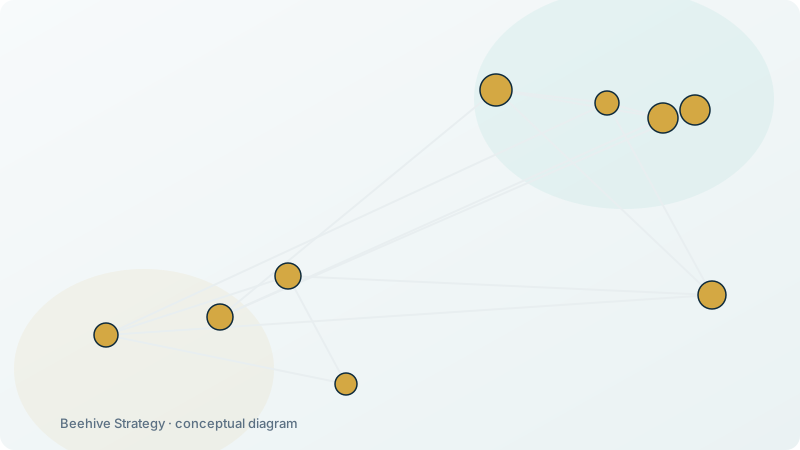
Human-AI collaboration in data teams exists on a spectrum, from AI-as-tool to AI-as-partner. At the tool end, humans use AI for discrete tasks — code generation, query drafting, summarization — while keeping traditional workflows intact. At the partner end, AI and humans work together on every analytical task, with the AI handling data-intensive components and the human supplying judgment-intensive ones. Most data teams in 2026 sit at the tool end of this spectrum, and that is precisely why their productivity gains remain modest: they automate a task here and there but never redesign how work flows.
The partner model requires explicit decisions about task allocation. For data access and query execution, AI should be the primary actor — using MCP connectors and a semantic layer to retrieve and process data faster and more consistently than any human could. For interpretation and insight generation, AI should produce the initial analysis that humans refine, validate, and contextualize. For stakeholder communication and decision support, humans should remain the primary actor — applying relationship management and judgment that AI cannot replicate, with AI-generated insight as input. For governance and quality assurance, AI handles automated monitoring while humans define policy and resolve exceptions.
This allocation is not static; it evolves as AI capabilities improve and as the team builds confidence in AI performance. The governing principle is comparative advantage: humans focus where their edge is largest (judgment, creativity, relationships), and AI focuses where its edge is largest (data processing, pattern recognition, consistency). Teams that write this allocation down, review it quarterly, and adjust it as capabilities shift report roughly 50% higher productivity than teams where the split emerges ad hoc — a finding consistent across our client engagements and the wider industry data on AI-augmented analytics teams.
How Do You Redesign Team Structures for Collaboration?
The traditional data team structure — data engineers, data analysts, and data scientists organized by technical function — was designed for a world where humans did every step of the pipeline. It does not support effective human-AI collaboration, because the boundaries it creates are technical rather than business-oriented. A better structure organizes the team around business domains and collaboration patterns: each domain team (sales analytics, supply chain analytics, finance analytics) combines human expertise with AI capabilities and defines clear roles for both.
The analytics engineer emerges as the pivotal role in this structure: a professional who understands both the business domain and the AI and semantic-layer infrastructure, and who serves as the bridge between business needs and AI capabilities. Their responsibilities include maintaining the semantic model for their domain, ensuring data quality for AI queries, validating AI-generated insights for business accuracy, and designing new analytical capabilities. The role demands a hybrid profile — SQL and data modeling, AI and machine learning fundamentals, domain expertise, communication, and data governance. It is hard to fill and enormously valuable: organizations with analytics engineers find these individuals roughly 3x more productive than traditional analysts, because AI absorbs the technical grunt work and they spend their time on business-value activities.
Domain structure also solves the accountability problem. When a sales leader asks why a number is wrong, the sales analytics team owns the answer end to end — the semantic definition, the data quality, and the AI's interpretation — instead of escalating across three technical silos. This is the same logic that drives modern data platform design: one governed semantic layer, reused across every domain, with clear ownership per domain. In our experience, teams that reorganize around domains report dramatically fewer "whose number is right?" disputes than teams that keep functional silos and bolt AI on top.
What New Success Metrics Fit Collaborative Teams?
Traditional data team metrics — dashboards delivered, reports created, queries answered — measure activity, not value, and they actively mislead once AI is in the loop. A team that ships 200 dashboards a quarter may still be failing if nobody acts on them. Collaborative teams need metrics that capture the value of human-AI work:
- Insight-to-decision ratio: what percentage of AI-generated insights lead to a documented business decision? This measures whether output actually drives value.
- Stakeholder satisfaction: how satisfied are business users with the data support they receive? This captures the quality of the human component of collaboration.
- AI utilization efficiency: what percentage of available AI capacity is being used effectively? This reveals whether the team is fully leveraging the platform.
- Knowledge creation rate: how many new analytical capabilities, semantic definitions, or data connections does the team create per month? This measures the compounding expansion of analytical capacity.
- Talent retention: what percentage of team members stay for two or more years? Well-designed human-AI workflows raise job satisfaction because professionals spend more time on intellectually stimulating work and less on repetitive extraction.
These metrics have a common thread: they measure outcomes and learning, not output. In our client work, teams that switch to outcome-based metrics discover that the AI absorbs exactly the work nobody wanted to do — the ad-hoc query queue, the metric reconciliation, the report formatting — and humans rediscover the analytical work that attracted them to the field in the first place. Retention follows naturally.
How Do You Know the Collaboration Model Is Working?
You can judge a human-AI collaboration model by four observable behaviors, not by slideware. First, watch the escalation pattern: if business users still route every question through a human analyst, the AI is not actually in the loop — it is a toy. Second, watch the exception queue: a healthy model surfaces AI uncertainty for human review early and often, so humans spend time on edge cases rather than routine queries. Third, watch the semantic layer: if definitions and metrics are being added and refined weekly, the collaboration is producing shared knowledge; if the layer is frozen, the team is not learning. Fourth, watch trust: do stakeholders question AI answers productively ("show me the source"), or do they quietly stop using the system? Productive questioning is the signature of a mature collaboration; silence is the failure mode.
A practical test we recommend to clients: take the ten questions your business leaders ask most often, and measure the median time from question to trusted, sourced answer before and after the collaboration model is in place. Teams that have done this see the median drop from days to minutes, with the AI handling retrieval and drafting while the human owns the final judgment. That is the whole point of the exercise — and it is achievable with conversational BI delivered inside the chat tools the business already uses.
How Do You Build the Collaborative Culture?
Technology enables human-AI collaboration, but culture determines whether it survives contact with the organization. Three cultural elements are essential. First, psychological safety: team members must feel safe questioning AI outputs, overriding AI recommendations, and reporting AI failures without fear of criticism. A culture that treats AI outputs as correct by default erodes trust in both directions — humans stop verifying, and then stop believing. Second, continuous learning: the team must actively share what the AI does well and where it falls short, building collective knowledge about its strengths and limitations rather than leaving each person to discover them alone. Third, outcome focus: measure and reward teams on business outcomes — decisions supported, insights delivered, questions answered with trust — rather than technical activity, so both human and AI contributions are judged by the value they create.
Culture also includes how the organization handles the transition. Roles change; some repetitive work disappears; new responsibilities appear. The teams that navigate this best are explicit about what changes and why, and they use the freed-up capacity deliberately — shifting analysts toward validation, narrative, and stakeholder work rather than leaving the hours unfilled. Beehive Strategy's platform supports this model by providing the AI capabilities — MCP connectors, a governed semantic layer, and conversational BI inside WeChat Work, DingTalk, Slack, and Teams — that handle the data-intensive components of the collaboration, standing up in about two weeks as a managed service without rebuilding the warehouse. That leaves the humans free to do the work only they can do: judging, contextualizing, and deciding.
What Roles Emerge in a Human-AI Data Team?
The team gains new shapes rather than losing people. The AI trainer specifies what good looks like and curates the examples; the reviewer validates model output before it reaches a decision; the translator sits between technical and business, turning questions into tasks the system can handle.
The data scientist becomes more of an orchestrator than a solo builder, and the domain expert becomes a teacher whose judgment is captured and reused. The point is not fewer roles but clearer ones, where each human does the part a model cannot.
How Do You Train Teams to Work With AI?
Training is mostly unlearning old habits. Teams must learn to write precise requests, to distrust confident wrong answers, and to treat the model as a fast first draft rather than a final authority. Short, repeated practice on real tasks beats a one-off workshop.
Build shared playbooks for the top workflows, celebrate teams that surface model errors, and make the feedback loop obvious. The teams that thrive are the ones that treat the model as a junior colleague — useful, fallible, and worth managing well.
What Are the Common Failure Modes of Collaboration?
The first failure is over-delegation: handing the model a decision it is not ready for and blaming it when things go wrong. The second is under-trust, where a capable model is ignored and people redo its work manually, wasting the investment.
The third is unclear ownership, so when output is wrong nobody knows who should catch it. Avoid these by scoping what the model may decide, instrumenting where it is used, and naming a human owner for every AI-assisted step. Collaboration fails at the boundaries, so define them.
How Do You Scale the Collaboration Model?
Scale by making the model the default path, not an opt-in extra. Embed it in the tools people already use, standardize the request patterns that work, and let successful teams publish their playbooks for others to copy.
Keep a central view of where AI assists which decisions, so the organization learns which patterns generalize. Scaling is less about bigger models and more about propagating the small habits and clear boundaries that already work in your best teams.
How Do You Measure Whether the Model Is Actually Helping?
Measure the team's output, not the model's alone. Compare cycle time, error rates, and decision quality before and after adoption, holding the task constant. If the model saves time but the human then re-checks everything, the net gain is smaller than it looks.
Track a few honest signals: how often the model's suggestion is accepted, how often it is corrected, and whether outcomes improved. A model that is frequently overridden is telling you where the collaboration is not yet real — and where to focus the next round of training and scoping.
What Does Good Human-AI Collaboration Look Like in Practice?
In practice it looks quiet and mundane: a analyst asks a precise question, gets a structured first draft in seconds, edits the parts that need judgment, and moves on. The model handles the predictable; the human spends attention where it changes the result.
The tell is proportion: effort flows to the decisions that matter, and routine work no longer consumes the day. Good collaboration is not a dramatic partnership — it is a steady, almost invisible division of labor that makes the whole team faster and more accurate.
What Is the Bottom Line for Human-AI Collaboration?
The bottom line is that the model does not replace the team; it changes how the team spends its attention. The wins go to organizations that clarify roles, define boundaries, and treat the model as a colleague to be managed rather than a tool to be feared or worshipped. The model is a multiplier, and like any multiplier it amplifies the process you already have — good habits or bad, in the end.
Collaboration is a design problem, not a procurement one. Build the habits, the ownership, and the feedback loop first, and the technology will deliver. Skip them and the same model that delights one team will quietly undermine another. The organizations that get this right treat collaboration as a capability they deliberately build, not a feature they buy. That capability compounds across every model they later adopt, turning a one-time win into a durable advantage.