AI analytics for healthcare organisations is at an inflection point in 2026. As healthcare cios and analytics directors navigate an increasingly complex landscape of regulatory requirements, technological capabilities, and competitive pressures, the gap between leaders and laggards is widening rapidly. Organisations that fail to adapt their approaches to AI analytics for healthcare organisations risk falling behind competitors who are leveraging AI, conversational BI, and enterprise AI agents to transform their operations. The central challenge — fragmented patient data across ehr, lab, and imaging systems limiting analytics — is no longer a theoretical concern but an operational imperative that demands immediate attention and strategic investment.
Key Insight: Healthcare AI analytics market projected to reach $22B by 2027. AI-driven predictive analytics reduces hospital readmission rates by 22%. The solution lies in ai agents unifying healthcare data through mcp for clinical and operational analytics, leveraging the Model Context Protocol (MCP) as the standardised integration foundation that makes this approach scalable, secure, and cost-effective across the enterprise.
What Is the Healthcare Data Fragmentation Challenge?
The current state of AI analytics for healthcare organisations presents significant challenges for healthcare cios and analytics directors. Healthcare data fragmentation costs the industry $34B annually. This statistic alone underscores the urgency of the situation: organisations that continue relying on outdated approaches are not merely standing still — they are actively falling behind as competitors leverage AI, conversational BI, and enterprise AI agents to gain measurable advantages. The pressure is compounded by evolving regulatory frameworks, accelerating technological change, and rising stakeholder expectations that together create an environment where incremental improvement is insufficient.
The implications extend well beyond operational efficiency. MCP integration enables combining EHR, lab, and imaging data for unified analytics. For organisations that continue with legacy approaches, the cost of inaction compounds with each passing quarter. Healthcare AI analytics market projected to reach $22B by 2027. These numbers tell a clear story: the gap between AI-enabled organisations and their peers is not narrowing — it is widening at an accelerating rate. The question for healthcare cios and analytics directors is no longer whether to transform their approach to AI analytics for healthcare organisations but how quickly they can do so while managing risk appropriately.
AI-driven predictive analytics reduces hospital readmission rates by 22%. At the same time, the regulatory landscape continues to evolve, with new requirements from the EU AI Act, China's PIPL, and other frameworks creating additional compliance obligations. Clinical decision support with AI improves diagnostic accuracy by 18%. For healthcare cios and analytics directors, this creates a complex matrix of considerations where technical decisions, regulatory requirements, and business objectives must be balanced simultaneously. The organisations that navigate this complexity most effectively will be those that adopt standardised integration protocols like MCP, which provide a consistent architectural foundation across multiple regulatory jurisdictions and technology environments.
- Healthcare data fragmentation costs the industry $34B annually
- MCP integration enables combining EHR, lab, and imaging data for unified analytics
- Hospitals using AI analytics report 15% reduction in operational costs
- Healthcare AI analytics market projected to reach $22B by 2027
- AI-driven predictive analytics reduces hospital readmission rates by 22%
- Clinical decision support with AI improves diagnostic accuracy by 18%
How Is AI Used for Clinical Analytics and Decision Support?
Artificial intelligence is fundamentally changing how organisations approach AI analytics for healthcare organisations. MCP integration enables combining EHR, lab, and imaging data for unified analytics. The key enabler is the ability of AI systems — particularly AI agents and conversational BI platforms — to process vastly more data than humanly possible, identify subtle patterns that traditional analytical approaches miss entirely, and deliver actionable insights at the speed that modern business decision-making demands. Hospitals using AI analytics report 15% reduction in operational costs. This represents a paradigm shift from reactive, report-driven approaches to proactive, insight-driven operations.
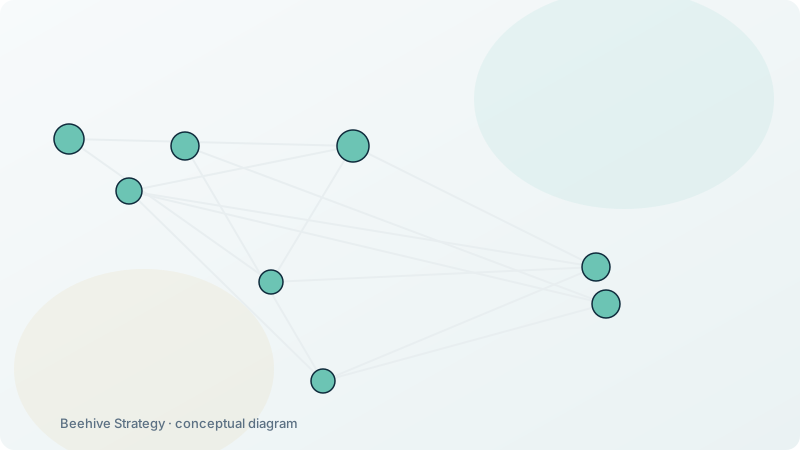
The Model Context Protocol (MCP) plays a central role in this transformation by providing a standardised way for AI agents to connect to enterprise data sources. By eliminating the custom integration work that has historically limited the scope and speed of AI deployments, MCP enables healthcare cios and analytics directors to deploy solutions that span their entire data landscape rather than being confined to individual data silos. Clinical decision support with AI improves diagnostic accuracy by 18%. This architectural advantage is particularly significant for AI analytics for healthcare organisations, where the value of AI is directly proportional to the breadth and quality of data it can access. Connecting EHR systems, lab information systems, and imaging platforms for unified healthcare analytics.
Healthcare data fragmentation costs the industry $34B annually. The combination of AI agents, conversational BI, and MCP creates a powerful new capability layer that sits between business users and their data infrastructure. Rather than requiring specialised technical skills to extract insights, healthcare cios and analytics directors can now interact with their data using natural language, asking complex questions and receiving accurate, contextual answers in seconds. MCP integration enables combining EHR, lab, and imaging data for unified analytics. At Beehive Strategy, we have seen organisations achieve transformative results by deploying this integrated approach, with measurable improvements in decision-making speed, accuracy, and user adoption rates across all business functions.
- MCP integration enables combining EHR, lab, and imaging data for unified analytics
- Hospitals using AI analytics report 15% reduction in operational costs
- Healthcare AI analytics market projected to reach $22B by 2027
- Clinical decision support with AI improves diagnostic accuracy by 18%
- Healthcare data fragmentation costs the industry $34B annually
- MCP integration enables combining EHR, lab, and imaging data for unified analytics
What Operational Analytics Matter Most in Healthcare?
Successful implementation of AI analytics for healthcare organisations solutions requires careful attention to architecture, integration patterns, and organisational change management. Healthcare AI analytics market projected to reach $22B by 2027. The technical foundation must support both current operational needs and future scalability requirements, which is where MCP's standardised approach provides a significant and measurable advantage over traditional point-to-point integration methods. AI-driven predictive analytics reduces hospital readmission rates by 22%. Organisations that invest in proper architecture upfront consistently report faster deployment timelines, lower maintenance costs, and higher user satisfaction.
Security and governance considerations must be embedded from the outset rather than bolted on after deployment. Healthcare data fragmentation costs the industry $34B annually. MCP's built-in permission model provides protocol-level access controls that ensure AI agents can only access the data they are explicitly authorised to use, creating a comprehensive audit trail that supports both internal governance requirements and external regulatory compliance. MCP integration enables combining EHR, lab, and imaging data for unified analytics. This is not a minor technical detail but a strategic architectural decision that fundamentally affects total cost of ownership, operational flexibility, and long-term maintainability of the entire AI analytics for healthcare organisations infrastructure.
Hospitals using AI analytics report 15% reduction in operational costs. At Beehive Strategy, we recommend evaluating any AI analytics for healthcare organisations solution on its integration architecture and governance capabilities first, as these foundational elements determine how quickly and effectively the solution can deliver measurable business value. The difference between a well-architected deployment and a hastily assembled one is not marginal — it often determines whether the initiative succeeds or fails entirely. Clinical decision support with AI improves diagnostic accuracy by 18%.
- Healthcare AI analytics market projected to reach $22B by 2027
- AI-driven predictive analytics reduces hospital readmission rates by 22%
- Clinical decision support with AI improves diagnostic accuracy by 18%
- Healthcare data fragmentation costs the industry $34B annually
- MCP integration enables combining EHR, lab, and imaging data for unified analytics
- Hospitals using AI analytics report 15% reduction in operational costs
What Regulatory and Privacy Rules Must Healthcare AI Respect?
The path to transforming AI analytics for healthcare organisations within your organisation requires a structured, phased approach that balances ambition with pragmatism. Begin with a focused assessment of your current capabilities, data readiness, and strategic priorities. MCP integration enables combining EHR, lab, and imaging data for unified analytics. This initial investment in understanding creates the foundation for all subsequent decisions and significantly reduces the risk of costly missteps. Hospitals using AI analytics report 15% reduction in operational costs. Organisations that skip this assessment phase consistently encounter problems later in their implementation that could have been avoided with proper upfront planning.
AI-driven predictive analytics reduces hospital readmission rates by 22%. Phase two should focus on building the core technical infrastructure — including MCP connectors, semantic layers, and governance frameworks — that will support scaled deployment. Clinical decision support with AI improves diagnostic accuracy by 18%. Phase three expands the solution across additional use cases and business functions, leveraging the lessons learned and reusable components from the initial deployment to accelerate adoption. Healthcare AI analytics market projected to reach $22B by 2027. This phased approach ensures that the organisation builds internal capability and confidence progressively rather than attempting a risky big-bang deployment.
Healthcare data fragmentation costs the industry $34B annually. For healthcare cios and analytics directors, the business case is increasingly compelling: the cost of inaction now demonstrably exceeds the cost of transformation. Healthcare data fragmentation costs the industry $34B annually. At Beehive Strategy, we work with organisations across industries to design and implement AI analytics for healthcare organisations strategies that deliver measurable results within 90 days while building the architectural foundation for long-term competitive advantage. The organisations that will lead in 2026 and beyond are those that act now — not with tentative pilots that never scale, but with decisive, well-architected deployments that create lasting value.
- MCP integration enables combining EHR, lab, and imaging data for unified analytics
- Hospitals using AI analytics report 15% reduction in operational costs
- Healthcare AI analytics market projected to reach $22B by 2027
- AI-driven predictive analytics reduces hospital readmission rates by 22%
- Clinical decision support with AI improves diagnostic accuracy by 18%
- Healthcare data fragmentation costs the industry $34B annually
How Can Healthcare Organisations Measure ROI from AI Analytics?
Measuring return on investment for AI analytics is different from measuring a conventional IT project. The value rarely appears as a single line item; it accrues across clinical outcomes, operational efficiency, and avoided cost. The organisations that report the strongest returns are those that define success metrics before deployment rather than retrospectively hunting for proof after the fact.
Start with a baseline. Capture current readmission rates, average length of stay, diagnostic turnaround times, and the staff hours spent on manual reporting. AI-driven predictive analytics has been associated with a 22% reduction in hospital readmission rates and an 18% improvement in diagnostic accuracy, but those gains only become attributable once you have a clean pre-deployment benchmark to compare against.
Separate clinical ROI from operational ROI. Clinical returns surface as fewer adverse events, shorter stays, and better disease management under value-based care contracts. Operational returns surface as optimised staffing, smoother bed management, and the 15% reduction in overhead costs reported by hospitals running mature analytics programs. Each category needs its own instrumentation and its own owner.
A practical measurement framework follows four steps: state a testable hypothesis, instrument the data capture needed to evaluate it, run a controlled comparison against the baseline, and attribute realised value back to the specific model or workflow. Resist vanity metrics such as dashboard logins; what matters is whether a decision changed and what that decision was worth.
Finally, reinvest a portion of proven savings into the next use case. This compounding loop is what separates organisations that treat AI analytics as a one-off pilot from those that build a durable, measurable capability across the enterprise.
What Does a Practical Roadmap to Healthcare AI Analytics Look Like?
The organisations that succeed with healthcare AI analytics rarely start with a hospital-wide platform; they start with a single workflow where the data already exists and the decision is high-stakes. A practical roadmap begins with a 90-day pilot on one use case, such as discharge planning or appointment no-show prediction, where a measurable outcome already has an owner. The pilot forces the boring but decisive work to happen first: standing up a governed data pipeline, agreeing on a labelling convention, and defining how a clinician will act on the model's output rather than merely reading it. Early wins build the trust that later, broader rollouts depend on.
From there, the programme expands along two axes. Technically, teams move from one model to a reusable analytics foundation: a semantic layer that maps clinical and operational terms to source systems, an evaluation harness that scores every model on the same held-out data, and monitoring that flags drift in both data and performance. Organisationally, they shift from project funding to platform funding, so that the next use case costs a fraction of the first. The governance model matures in parallel, with privacy review, model cards, and incident response becoming routine rather than exceptional. The destination is not a single flagship model but a steady cadence of safe, auditable analytics that clinicians actually use, which is the only version of AI adoption that survives contact with a real healthcare system.