Enterprise adoption of total cost of ownership for enterprise AI is accelerating in 2026, yet many cfos and ai programme sponsors continue to struggle with hidden costs in ai projects leading to budget overruns and failed deployments. The emergence of AI agents, conversational BI platforms, and standardised integration protocols like MCP is creating entirely new possibilities for organisations willing to rethink their approach from the ground up. The evidence is clear: early adopters are already demonstrating measurable improvements in efficiency, accuracy, and decision-making speed. Those who act decisively now will establish lasting competitive advantages that become increasingly difficult to replicate.
Key Insight: 68% of AI projects exceed their initial budget by 50% or more. Average enterprise AI TCO is 3.2x the initial platform licensing cost. The solution lies in comprehensive tco framework covering infrastructure, talent, data, and ongoing operations, leveraging the Model Context Protocol (MCP) as the standardised integration foundation that makes this approach scalable, secure, and cost-effective across the enterprise.
The Hidden Cost Problem in Enterprise AI
The current state of total cost of ownership for enterprise AI presents significant challenges for cfos and ai programme sponsors. Hidden data preparation costs average 35% of total AI project spend. This statistic alone underscores the urgency of the situation: organisations that continue relying on outdated approaches are not merely standing still — they are actively falling behind as competitors leverage AI, conversational BI, and enterprise AI agents to gain measurable advantages. The pressure is compounded by evolving regulatory frameworks, accelerating technological change, and rising stakeholder expectations that together create an environment where incremental improvement is insufficient.
The implications extend well beyond operational efficiency. Ongoing model maintenance consumes 40% of AI team capacity. For organisations that continue with legacy approaches, the cost of inaction compounds with each passing quarter. Organisations with mature TCO practices deliver AI projects 25% under average budget. These numbers tell a clear story: the gap between AI-enabled organisations and their peers is not narrowing — it is widening at an accelerating rate. The question for cfos and ai programme sponsors is no longer whether to transform their approach to total cost of ownership for enterprise AI but how quickly they can do so while managing risk appropriately.
68% of AI projects exceed their initial budget by 50% or more. At the same time, the regulatory landscape continues to evolve, with new requirements from the EU AI Act, China's PIPL, and other frameworks creating additional compliance obligations. Average enterprise AI TCO is 3.2x the initial platform licensing cost. For cfos and ai programme sponsors, this creates a complex matrix of considerations where technical decisions, regulatory requirements, and business objectives must be balanced simultaneously. The organisations that navigate this complexity most effectively will be those that adopt standardised integration protocols like MCP, which provide a consistent architectural foundation across multiple regulatory jurisdictions and technology environments.
- Hidden data preparation costs average 35% of total AI project spend
- Ongoing model maintenance consumes 40% of AI team capacity
- MCP-based integration reduces integration costs by 55% vs custom connectors
- Organisations with mature TCO practices deliver AI projects 25% under average budget
- 68% of AI projects exceed their initial budget by 50% or more
- Average enterprise AI TCO is 3.2x the initial platform licensing cost
Components of AI Total Cost of Ownership
Artificial intelligence is fundamentally changing how organisations approach total cost of ownership for enterprise AI. Ongoing model maintenance consumes 40% of AI team capacity. The key enabler is the ability of AI systems — particularly AI agents and conversational BI platforms — to process vastly more data than humanly possible, identify subtle patterns that traditional analytical approaches miss entirely, and deliver actionable insights at the speed that modern business decision-making demands. MCP-based integration reduces integration costs by 55% vs custom connectors. This represents a paradigm shift from reactive, report-driven approaches to proactive, insight-driven operations.
The Model Context Protocol (MCP) plays a central role in this transformation by providing a standardised way for AI agents to connect to enterprise data sources. By eliminating the custom integration work that has historically limited the scope and speed of AI deployments, MCP enables cfos and ai programme sponsors to deploy solutions that span their entire data landscape rather than being confined to individual data silos. Organisations with mature TCO practices deliver AI projects 25% under average budget. This architectural advantage is particularly significant for total cost of ownership for enterprise AI, where the value of AI is directly proportional to the breadth and quality of data it can access. Reducing integration and maintenance costs through standardised, pluggable data connectors.
MCP-based integration reduces integration costs by 55% vs custom connectors. The combination of AI agents, conversational BI, and MCP creates a powerful new capability layer that sits between business users and their data infrastructure. Rather than requiring specialised technical skills to extract insights, cfos and ai programme sponsors can now interact with their data using natural language, asking complex questions and receiving accurate, contextual answers in seconds. Ongoing model maintenance consumes 40% of AI team capacity. At Beehive Strategy, we have seen organisations achieve transformative results by deploying this integrated approach, with measurable improvements in decision-making speed, accuracy, and user adoption rates across all business functions.
- Ongoing model maintenance consumes 40% of AI team capacity
- MCP-based integration reduces integration costs by 55% vs custom connectors
- Organisations with mature TCO practices deliver AI projects 25% under average budget
- Organisations with mature TCO practices deliver AI projects 25% under average budget
- MCP-based integration reduces integration costs by 55% vs custom connectors
- Ongoing model maintenance consumes 40% of AI team capacity
How Architecture Choices Impact TCO
Successful implementation of total cost of ownership for enterprise AI solutions requires careful attention to architecture, integration patterns, and organisational change management. Average enterprise AI TCO is 3.2x the initial platform licensing cost. The technical foundation must support both current operational needs and future scalability requirements, which is where MCP's standardised approach provides a significant and measurable advantage over traditional point-to-point integration methods. 68% of AI projects exceed their initial budget by 50% or more. Organisations that invest in proper architecture upfront consistently report faster deployment timelines, lower maintenance costs, and higher user satisfaction.
Security and governance considerations must be embedded from the outset rather than bolted on after deployment. MCP-based integration reduces integration costs by 55% vs custom connectors. MCP's built-in permission model provides protocol-level access controls that ensure AI agents can only access the data they are explicitly authorised to use, creating a comprehensive audit trail that supports both internal governance requirements and external regulatory compliance. Ongoing model maintenance consumes 40% of AI team capacity. This is not a minor technical detail but a strategic architectural decision that fundamentally affects total cost of ownership, operational flexibility, and long-term maintainability of the entire total cost of ownership for enterprise AI infrastructure.
Hidden data preparation costs average 35% of total AI project spend. At Beehive Strategy, we recommend evaluating any total cost of ownership for enterprise AI solution on its integration architecture and governance capabilities first, as these foundational elements determine how quickly and effectively the solution can deliver measurable business value. The difference between a well-architected deployment and a hastily assembled one is not marginal — it often determines whether the initiative succeeds or fails entirely. Organisations with mature TCO practices deliver AI projects 25% under average budget.
- Average enterprise AI TCO is 3.2x the initial platform licensing cost
- 68% of AI projects exceed their initial budget by 50% or more
- Organisations with mature TCO practices deliver AI projects 25% under average budget
- MCP-based integration reduces integration costs by 55% vs custom connectors
- Ongoing model maintenance consumes 40% of AI team capacity
- Hidden data preparation costs average 35% of total AI project spend
Optimising TCO: A Practical Framework
The path to transforming total cost of ownership for enterprise AI within your organisation requires a structured, phased approach that balances ambition with pragmatism. Begin with a focused assessment of your current capabilities, data readiness, and strategic priorities. Ongoing model maintenance consumes 40% of AI team capacity. This initial investment in understanding creates the foundation for all subsequent decisions and significantly reduces the risk of costly missteps. Hidden data preparation costs average 35% of total AI project spend. Organisations that skip this assessment phase consistently encounter problems later in their implementation that could have been avoided with proper upfront planning.
68% of AI projects exceed their initial budget by 50% or more. Phase two should focus on building the core technical infrastructure — including MCP connectors, semantic layers, and governance frameworks — that will support scaled deployment. Organisations with mature TCO practices deliver AI projects 25% under average budget. Phase three expands the solution across additional use cases and business functions, leveraging the lessons learned and reusable components from the initial deployment to accelerate adoption. Average enterprise AI TCO is 3.2x the initial platform licensing cost. This phased approach ensures that the organisation builds internal capability and confidence progressively rather than attempting a risky big-bang deployment.
MCP-based integration reduces integration costs by 55% vs custom connectors. For cfos and ai programme sponsors, the business case is increasingly compelling: the cost of inaction now demonstrably exceeds the cost of transformation. Hidden data preparation costs average 35% of total AI project spend. At Beehive Strategy, we work with organisations across industries to design and implement total cost of ownership for enterprise AI strategies that deliver measurable results within 90 days while building the architectural foundation for long-term competitive advantage. The organisations that will lead in 2026 and beyond are those that act now — not with tentative pilots that never scale, but with decisive, well-architected deployments that create lasting value.
- Ongoing model maintenance consumes 40% of AI team capacity
- Hidden data preparation costs average 35% of total AI project spend
- Average enterprise AI TCO is 3.2x the initial platform licensing cost
- 68% of AI projects exceed their initial budget by 50% or more
- Organisations with mature TCO practices deliver AI projects 25% under average budget
- MCP-based integration reduces integration costs by 55% vs custom connectors
Why Does the True Cost of Enterprise AI Stay Hidden?
Most enterprises budget for enterprise AI as if it were a software purchase: a license, a cloud line item, and a project plan. The actual total cost of ownership is far wider, and the parts that get left out are exactly the parts that sink the business case two years later. The model API bill is visible; the data engineering, the evaluation harness, the permission remediation, and the ongoing curation of sources are not, because they are staffed by people already on the payroll and therefore appear as "free."
The second reason costs hide is that AI systems degrade. A retrieval pipeline that is accurate on launch day is not accurate on day 200 unless someone maintains the corpus, re-runs the golden set, and retrains or swaps embeddings. That maintenance is a permanent operating cost that the initial build budget never includes. Gartner has repeatedly flagged that enterprises underestimate the steady-state run cost of generative systems by a factor of two to three.
The third hidden cost is failure cost: a confident wrong answer in a pricing, compliance, or safety context produces rework, escalations, and occasionally regulatory exposure. These are not line items; they are variance against the outcomes the AI was meant to improve. A credible TCO model puts a number on expected error cost and compares it to the error cost of the manual process it replaces.
What Actually Belongs in an AI Total Cost of Ownership Model?
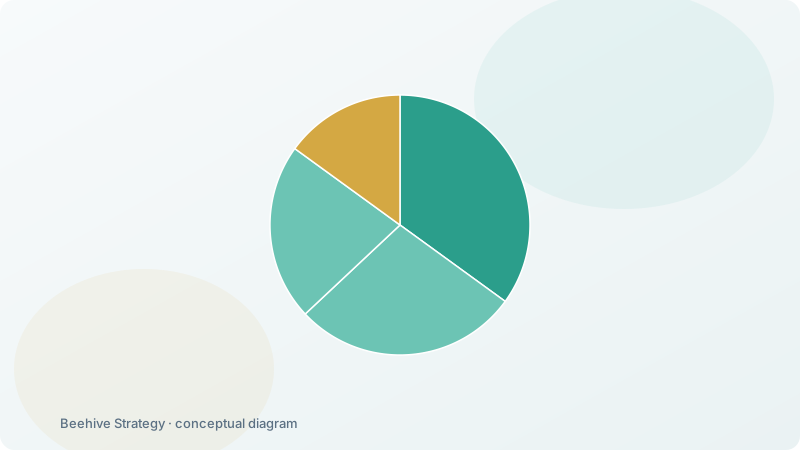
A usable TCO model has five buckets. Compute and inference is the easiest: tokens, GPUs, and vector database queries. Data preparation is the largest and most underestimated: connectors, normalization, deduplication, and the permission mapping that makes retrieval safe. Evaluation and assurance covers the golden set, red-teaming, and the abstain-rate monitoring that proves the system is still honest. Change management covers training, adoption programs, and the internal support line. And risk reserve covers the expected cost of errors and the compliance review cycle.
Within data preparation, permission remediation deserves its own line. Enterprises routinely discover that the source systems they want to search were never governed: documents are world-readable, ownership is unclear, and "current" is undefined. Making retrieval safe means paying that governance debt, and it is almost always the longest pole in the schedule. Teams that budget only for the model and the demo arrive at production and stall on permissions.
Inference strategy is the lever with the widest swing. Routing simple queries to a small model and reserving the large model for hard cases, caching embeddings, and pre-computing answers for the recurring top questions can cut the compute bucket by more than half without changing the user experience. The TCO discipline is less about picking the cheapest model and more about matching model size to question difficulty.
How Do Architecture Choices Change the TCO Equation?
Architecture decides which cost buckets grow and which shrink. A managed, governed service like Beehive Strategy's — deployed in roughly two weeks with unified permissions and curated sources — converts the data-preparation and change-management buckets from open-ended internal programs into a scoped, predictable line item. The trade-off is a subscription instead of a build, but for most enterprises the build cost is the part they undercount.
A self-build on raw foundation models maximizes flexibility and minimizes nothing else: every bucket becomes an internal responsibility, and the evaluation harness alone is a multi-quarter effort. A hybrid — managed retrieval with in-house orchestration — splits the difference but creates an integration边界 that itself needs ownership. The TCO question is not "which is cheapest" but "which cost profile matches our ability to staff it."
The architecture choice that most reduces TCO over three years is the one that keeps the corpus governed. A system that starts clean and stays clean avoids the compounding cost of decaying sources, because the evaluation harness keeps catching regressions before users do. Architecture is a TCO decision long before it is a technical one.
How Do You Actually Optimise AI Total Cost of Ownership?
Optimisation starts with measurement: instrument token spend per question, corpus refresh cost per repository, and evaluation hours per release. You cannot optimise a bucket you cannot see, and most enterprises have never measured their retrieval maintenance at all. Once visible, the fastest wins are routing, caching, and retiring connectors that no one uses.
The next win is scope discipline. Each additional repository adds a permission model, a curation owner, and a golden-set slice; the disciplined program expands only when the current repository is green on its success metric. The undisciplined program connects everything, watches quality fall, and pays for it in adoption loss. Optimising TCO is mostly saying no to the next integration until the last one is trustworthy.
Finally, optimise for honesty, not just for cost. A cheaper system that answers confidently and wrongly trades a small inference saving for a large error cost, and the error cost is the one that ends the program. The TCO model that survives contact with production is the one that prices both.