The direct answer for governance teams is that in the age of AI, data lineage is no longer a documentation nicety — it is the mechanism that makes AI trustworthy, auditable, and defensible, and enterprises with mature lineage and governance practices report up to 40% higher AI model accuracy, 55% faster compliance audit cycles, and roughly 3x faster time-to-production for new AI use cases. Data Lineage in the Age of AI: Tracing Data Flows for Governance and Compliance explains what lineage must capture, how to build it, and how to keep it enforceable as AI systems scale.
Data lineage is the quiet backbone of AI governance. Every regulated or high-stakes AI system ultimately has to answer a simple, brutal question: where did this number, this training example, this decision come from? Without lineage, the answer is a shrug, and a shrug is a compliance failure. With lineage, the answer is a path you can walk — from output back through transformation, source, and owner.
In the AI era, lineage is harder and more important than in the BI era. Training data is assembled from many sources, transformed by pipelines, and consumed by models whose behavior depends on all of it. A bias, a PII leak, or a stale figure can enter anywhere along that path and only surface much later. Governance that cannot trace the path cannot fix the cause, only the symptom.
How Do You Trace Data Through an AI Pipeline?
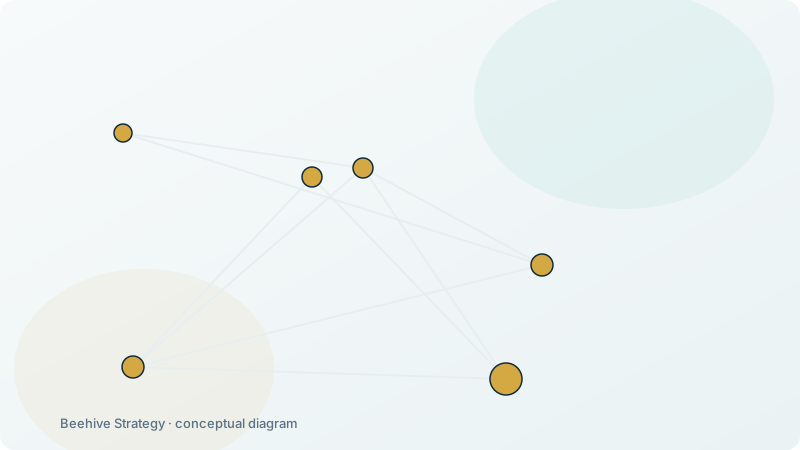
Tracing starts by treating every dataset, feature, and model version as a named, versioned artifact with a recorded provenance. When a pipeline reads sources, transforms them, and feeds a model, each step is logged with inputs, code version, and outputs. A column in a report can then be traced to the model that produced it, the feature that informed it, and the source that supplied it — automatically, not by a forensic analyst working backward from a screenshot.
Integration with conversational BI closes the loop: a user who questions a figure can be shown its lineage in plain language, and a compliance officer can produce the same trail on demand. This alignment turns lineage from a documentation chore into a live control — the system knows where everything came from because it recorded it at every step.
Start where the risk is highest: regulated outputs and customer-affecting decisions. Instrument their lineage first. The trail you build there becomes reusable infrastructure for everything else, and it is the single most defensible investment in AI governance you can make.
Data Governance in the AI Era
AI proliferation has fundamentally changed the stakes of data governance. When a human analyst makes a decision on flawed data, the impact is contained and correctable. When AI automates thousands of decisions on the same flawed data, the impact scales exponentially — and so does the exposure. This amplification effect is why governance has become a critical enabler of trustworthy AI rather than a compliance afterthought.
The economics reinforce the argument. Gartner has long estimated that poor data quality costs organizations an average of $12.9 million per year, and those costs multiply when defective data flows into models that are then trusted at scale. Modern governance must therefore evolve beyond traditional warehousing concerns to address AI-specific requirements: training data quality, model metadata and lineage, consistent access policy enforcement across AI interfaces, and audit trails that satisfy both regulators and internal accountability.
The shift is visible in practice: enterprises with mature lineage programs consistently report the accuracy, audit-speed, and time-to-production advantages cited above, because lineage turns governance from an annual review into a continuous, machine-readable property of the data platform.
How Do You Trace Data Through an AI Pipeline?
Tracing data through an AI pipeline means building an end-to-end map from source system to final model output: every table, field, transformation, feature, training run, and inference logged so that any output can be walked back to its origins. Column-level lineage is the practical standard — knowing that a model's credit-score feature traces to three source columns, one vendor file, and two transformations — because that is the granularity regulators and incident investigators actually need.
The trace must cover four segments. The first is source provenance: where raw data comes from and under what consent or licensing terms. The second is pipeline transformation: every join, filter, imputation, and aggregation that changes the data before it reaches training or inference. The third is model lineage: which dataset versions trained which model versions, with their evaluation results. The fourth is output traceability: which model version and data snapshot produced a given answer, recommendation, or automated action.
- Capture at creation: instrument lineage at the point data is written, not reconstructed later — reconstruction is error-prone and near-impossible at scale.
- Automate continuously: lineage should update with every pipeline run, not through periodic manual diagrams.
- Bind to policy: every lineage node carries its classification, retention, and access rules so governance travels with the data.
- Expose to consumers: lineage must be queryable by AI teams, auditors, and data stewards without custom engineering.
- Version everything: store lineage versions alongside data versions so historical outputs remain explainable after schema changes.
Done well, this tracing converts the pipeline from a black box into an explainable artifact — which is exactly what both model-risk teams and regulators are asking for.
Framework Design and Implementation
Effective governance operates across three tiers. At the strategic tier, the data governance council sets policies and oversight. At the tactical tier, data stewards define domain-specific rules and quality standards. At the operational tier, automated checks, monitoring, and enforcement run continuously in pipelines and AI workflows. Lineage is the connective tissue that lets each tier see what the others are doing.
The implementation roadmap should follow a deliberate sequence. First, build governance foundations: cataloguing, ownership, and policies. Second, add automated capabilities: quality monitoring, lineage capture, and access control. Third — and only then — integrate governance into AI workflows with training validation, model governance, and production monitoring. Enterprises that skip the foundation phase and bolt lineage onto mature systems typically pay 2–3x the integration cost and never reach full coverage.
Pilot the framework on one high-stakes domain first — a data domain feeding a regulated model — prove the mechanics, then extend. This phased approach builds both technical capability and organizational trust, and it gives audit teams an early, demonstrable win.
Integration with AI and Conversational BI
Governance and AI must be deeply integrated, and the integration point in 2026 is the data access layer. When users query data through conversational BI — increasingly via MCP connectors — the governance layer should enforce access policies, apply quality filters, and log interactions. This creates a governance-aware access layer that protects data without creating friction for users, which is the difference between governance that works and governance that is bypassed.
Conversational analytics adds a governance obligation: every answer an executive receives should be traceable to its sources, so that trust in AI-generated insight rests on lineage rather than confidence in the model. Platforms such as Beehive Strategy's conversational BI surface this provenance naturally, letting users see where an answer's numbers come from — turning lineage from a back-office artifact into a user-facing trust feature.
AI can also enhance governance itself: automated classification for sensitivity levels, anomaly detection for quality issues, and ML-based lineage analysis for mapping data flows across millions of assets. These AI-powered tools are what make governance at scale feasible; manual stewardship simply cannot keep pace with modern data growth.
Compliance and Regulatory Alignment
Governance frameworks must align with an evolving regulatory stack: the EU AI Act — whose high-risk obligations begin applying on August 2, 2026 — China's PIPL, the GDPR, and sectoral regulations in finance, health, and energy. A well-designed framework should be modular, accommodating new requirements without fundamental redesign, and lineage is the common denominator most regulators are converging on as the evidence they will ask to see.
Regular governance audits should evaluate quality levels, access control effectiveness, lineage documentation, and policy compliance. Auditors increasingly expect to test lineage directly: pick a model output, walk it back to source, and verify that every step was governed. Enterprises that cannot pass that test — even for legacy systems — should treat remediation as a priority investment, because the test is coming whether it is administered by the EU, by a sector regulator, or by a customer's procurement team.
Conversational BI makes governance metrics accessible to stakeholders, enabling data-driven governance improvement: when governance dashboards answer plain-language questions such as "which data domains lack lineage coverage?", fixing gaps becomes a managed program rather than an act of faith.
Frequently Asked Questions
How does data governance impact AI model performance? Governance directly impacts performance through data quality, consistency, and accessibility. Poor governance produces biased, inconsistent training data and unreliable outputs; mature frameworks yield up to 40% higher model accuracy and materially faster remediation when quality issues surface.
What is the relationship between MCP and data governance? MCP enhances governance by providing a standardized, governed access layer. MCP connectors enforce access policies, maintain audit trails, and ensure lineage visibility, enabling consistent governance across all connected systems — including conversational AI interfaces.
How should enterprises prioritize governance investments? Prioritize based on AI risk exposure: data domains feeding high-stakes systems receive the highest investment. Start with foundations like cataloguing and ownership, then layer on automated lineage, quality monitoring, and access control as AI adoption scales.
How Do You Make Lineage Usable, Not Shelfware?
Lineage becomes shelfware when it is documented but never queried. Make it usable by connecting it to the questions people actually ask: a user questioning a figure in conversational BI sees its lineage; an engineer debugging a regression walks the graph; a compliance officer answers an inquiry from the same trail. Lineage that is read, not just written, is the live control it was meant to be.
The design choice that enables this is recording provenance at every step rather than reconstructing it after. Each dataset, feature, and model version is a named, versioned artifact; each run logs inputs, code, and outputs. The graph is then queryable on demand, and the cost of answering "where did this come from" drops from a forensic project to a click.
The strategic value is resilience. When a model behaves oddly or a regulator asks a hard question, the answer is already there in the graph, and the incident becomes a quick fix rather than a crisis. Start where risk is highest, instrument lineage there first, and it becomes reusable infrastructure — the single most defensible investment in AI governance, cheap to start and impossible to retrofit once you need it.
How Do You Start a Lineage Program?
Start where the risk is highest: regulated outputs and customer-affecting decisions. For those systems, record provenance at every step — dataset, feature, model version, pipeline run — so any figure can be traced to its source on demand. You do not need to instrument the whole estate on day one; you need to prove the value on the systems where a wrong answer is a violation, not a typo.
The second move is to connect lineage to conversational BI, so a questioned figure returns its own history in plain language. That single integration turns lineage from documentation into a live control used daily by analysts and auditors alike. The third move is to make the graph queryable, so debugging a regression is a walk, not a forensic project.
Resist the urge to boil the ocean. A lineage program that covers the ten riskiest systems completely is worth more than one that partially covers a thousand. Prove it where it matters, expand as the practice is accepted, and the trail becomes reusable infrastructure — the single most defensible investment in AI governance, cheap to start and impossible to retrofit once a regulator is asking and the answer is not there.
Frequently Asked Questions
How Do You Integrate Lineage With AI and Conversational BI?
Integration is where lineage pays off daily. When a user questions a figure in conversational BI, the system should be able to show its lineage in plain language — this number came from that model, trained on those features, sourced from those systems, owned by those teams. That same trail satisfies a compliance officer's information request and lets an engineer debug a regression without a forensic marathon. Lineage stops being documentation and becomes a live control.
The design principle is to record provenance at every step, not reconstruct it after. Each dataset, feature, and model version is a named, versioned artifact; each pipeline run logs its inputs, code, and outputs. Conversational BI then reads that recorded graph to answer "where did this come from," and governance reads the same graph to prove it. One infrastructure, two payoffs.
What Compliance Alignment Does Lineage Enable?
Lineage enables the answers regulators actually want: can you show the basis for a decision, the data behind a model, and the controls on a transfer. For AI-adjacent personal information, lineage ties a model's behavior to the processing it inherited, so deletion and explanation rights can be honored against the right stores. For financial and safety-critical outputs, lineage provides the audit path that turns "we believe it's correct" into "we can prove how it was produced."
Start where risk is highest — regulated outputs and customer-affecting decisions — and instrument their lineage first. The trail you build there becomes reusable infrastructure, and it is the single most defensible investment in AI governance: cheap to start, impossible to retrofit, and continuously valuable once live.