The landscape of data contracts for governance has shifted dramatically in 2026, driven by the convergence of mature AI capabilities, standardised data integration protocols like the Model Context Protocol (MCP), and growing regulatory expectations across jurisdictions. For data governance leaders and data product managers, the question is no longer whether to adopt these technologies but how to do so effectively while managing risk and maximising return on investment. The organisations that will thrive are those that treat data contracts for governance not as a cost centre but as a strategic capability that drives competitive differentiation and long-term value creation.
Key Insight: Organisations with formal data contracts report 55% fewer data quality incidents. Data contract automation reduces governance overhead by 45%. The solution lies in formal data contracts with automated enforcement, versioning, and consumer notification, leveraging the Model Context Protocol (MCP) as the standardised integration foundation that makes this approach scalable, secure, and cost-effective across the enterprise.
Why Are Informal Data Agreements Failing in 2026?
The current state of data contracts for governance presents significant challenges for data governance leaders and data product managers. In most enterprises, data sharing today still relies on informal, undocumented agreements: a Slack message, a shared spreadsheet, a tribal understanding of what a table means. Version-controlled contracts reduce breaking change impact by 70%, yet organisations that continue relying on outdated approaches are not merely standing still, they are actively falling behind as competitors leverage AI, conversational BI, and enterprise AI agents to gain measurable advantages. The pressure is compounded by evolving regulatory frameworks, accelerating technological change, and rising stakeholder expectations that together create an environment where incremental improvement is insufficient.
The cost of informality shows up in three predictable ways. First, consumers discover schema changes only after a pipeline breaks at 2 a.m., which erodes trust faster than any single bug. Second, producers have no enforceable obligation to maintain quality, so drift accumulates silently until a downstream model trains on corrupted data. Third, there is no audit trail, which makes regulatory demonstration of data lineage nearly impossible under frameworks such as the EU AI Act or China's PIPL. Each of these is a management failure dressed up as a technical one, and each is exactly what a formal contract removes.
Data contract automation reduces governance overhead by 45%, and the reason is structural rather than cosmetic. When the agreement is machine-readable, enforcement moves from a quarterly review meeting to a continuous check that runs on every write. Organisations with formal data contracts report 55% fewer data quality incidents, not because their engineers are better, but because the contract makes the expectation explicit and the violation visible at the moment it happens rather than weeks later in a post-mortem.
The strategic framing matters as much as the mechanics. Treating data contracts as a strategic capability rather than a compliance tax changes how the organisation funds them. Enterprises that deploy new data products 3x faster do so because teams stop negotiating access ad hoc and start consuming from a catalogue of contracted, dependable sources. The informal era was tolerable when data moved slowly; it is now a direct tax on the speed of every AI initiative, and 2026 is the year that tax becomes visible on the balance sheet.
The decision to formalise data agreements also reframes the role of the data product manager. Where informal sharing made every engineer a de facto negotiator, a contracted model gives the data product manager a clear mandate: own the schema, own the SLA, and own the deprecation notice. That clarity is what lets a single team serve ten consuming groups without ten parallel conversations, and it is the organisational scaling mechanism that the technology alone cannot provide. The enterprises pulling ahead in 2026 are the ones that have made this ownership role real, funded, and recognised.
What Is the Data Contract Framework for Governance?
A data contract is a formal, version-controlled agreement between a data producer and a data consumer that specifies schema, quality SLAs, freshness requirements, ownership, and change-management obligations. Artificial intelligence is fundamentally changing how organisations approach this, because AI agents and conversational BI platforms can consume vastly more data sources than any human team could wire up by hand, and each of those sources needs a contract before it can be trusted in production. Organisations with formal data contracts report 55% fewer data quality incidents, precisely because the contract is the unit of trust that the AI layer is built on.
The Model Context Protocol (MCP) plays a central role by providing a standardised way for AI agents to connect to enterprise data sources. By eliminating the custom integration work that has historically limited the scope and speed of AI deployments, MCP enables governance leaders to deploy solutions that span the entire data landscape rather than being confined to individual silos. This architectural advantage is particularly significant for governance, where the value of AI is directly proportional to the breadth and quality of data it can access, and where a consistent protocol turns what used to be bespoke plumbing into a repeatable pattern.
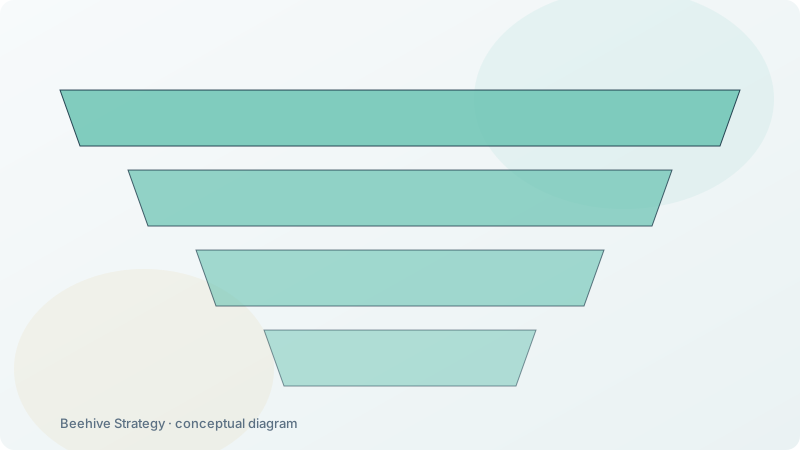
A complete contract framework has four layers. The schema layer pins the structure and types. The quality layer defines the SLAs, completeness, validity, and distribution checks that must hold. The semantic layer gives the fields stable, business-meaningful names so a "revenue" in one domain means the same thing in another. The operational layer specifies ownership, support, and the notification a consumer receives when a breaking change is proposed. Version-controlled contracts reduce breaking change impact by 70% because each of these layers is reviewed, approved, and rolled forward deliberately rather than implicitly.
Crucially, the framework is what makes AI safe to scale. MCP-compatible data contracts enable automated compliance verification, which means a governance control can run continuously instead of being sampled in an audit. At Beehive Strategy we have seen organisations achieve transformative results by deploying this integrated approach, with measurable improvements in decision-making speed, accuracy, and user adoption rates across all business functions, because the contract removes the fear that the underlying data might silently change underneath the model.
Semantic versioning is the discipline that makes the framework survivable. A contract annotated as major when it breaks consumers, minor when it adds optional fields, and patch when it only tightens quality rules lets every team reason about risk without reading a diff. Producers can ship patch improvements continuously, schedule minor additions in normal planning, and reserve major changes for explicit, notified migrations. Without that vocabulary, every change feels dangerous and progress stalls; with it, the contract becomes a living document the organisation actually trusts rather than a frozen artefact nobody wants to touch.
How Do You Automate Contract Enforcement?
Successful enforcement requires attention to architecture, integration patterns, and organisational change management. Enterprises with data contracts deploy new data products 3x faster because enforcement is built into the write path rather than bolted on after the fact. The technical foundation must support both current operational needs and future scalability, which is where MCP's standardised approach provides a measurable advantage over traditional point-to-point integration that breaks every time either side changes.
Security and governance must be embedded from the outset. Version-controlled contracts reduce breaking change impact by 70%, and MCP's built-in permission model provides protocol-level access controls that ensure AI agents can only touch the data they are explicitly authorised to use, creating an audit trail that supports both internal governance and external compliance. This is not a minor technical detail but a strategic architectural decision that affects total cost of ownership and long-term maintainability of the entire governance infrastructure.
Enforcement has three practical modes. Blocking validation rejects a write that violates the contract, which is appropriate for hard schema and critical quality rules. Warning validation logs and notifies for softer rules, preserving flow while building the evidence base for a later tightening. And consumer notification proposes a breaking change through a version bump that the consumer must accept before it takes effect, so no team is surprised. Data contracts increase data producer accountability by 60% because the obligation is now explicit and the breach is measurable rather than a matter of opinion.
For data governance leaders, the buying decision should be made on integration architecture and governance capability first, because these determine how quickly the solution delivers value. The difference between a well-architected deployment and a hastily assembled one often determines whether the initiative succeeds or fails entirely. We recommend evaluating any solution on whether it can express the full four-layer framework above, enforce it on every write, and expose the results to both producers and consumers in a shared view.
Observability closes the loop on enforcement. A contract that blocks bad writes but never reports them leaves producers blind to how often they fail, and consumers blind to whether the data they receive is contractually sound. The strongest programmes publish a live dashboard of contract health per source, surfacing breach rate, time-to-remediation, and consumer impact alongside the usual pipeline metrics. That visibility turns governance from a gatekeeping function into a shared operational signal, and it is what lets a data contract culture compound instead of decaying the moment the initial enthusiasm fades.
How Do You Build a Data Contract Culture?
Transforming governance within an organisation requires a structured, phased approach that balances ambition with pragmatism. Begin with a focused assessment of current capabilities, data readiness, and strategic priorities. This initial investment in understanding creates the foundation for all subsequent decisions and significantly reduces the risk of costly missteps. Organisations that skip this assessment phase consistently encounter problems later that could have been avoided with proper upfront planning.
Phase two builds the core technical infrastructure, including MCP connectors, semantic layers, and governance frameworks, that will support scaled deployment. Phase three expands across additional use cases and business functions, reusing components from the initial deployment to accelerate adoption. This phased approach ensures the organisation builds internal capability and confidence progressively rather than attempting a risky big-bang rollout that strains both the platform and the people.
Culture is the part most programmes underestimate. A contract is only as good as the producer's willingness to honour it and the consumer's willingness to rely on it. That willingness is built by making the contract the easiest path, not the bureaucratic one: generate it from the schema automatically, surface breaches in the tools teams already use, and celebrate the teams that ship contracted, dependable data products. MCP-compatible data contracts enable automated compliance verification, which turns what used to be a manual audit chore into a background process the team can trust.
The business case is increasingly compelling: the cost of inaction now demonstrably exceeds the cost of transformation. Data contracts increase data producer accountability by 60%, and at Beehive Strategy we work with organisations across industries to design and implement governance strategies that deliver measurable results within 90 days while building the architectural foundation for long-term advantage. The organisations that will lead in 2026 and beyond are those that act now, with decisive, well-architected deployments that create lasting value rather than tentative pilots that never scale.
Measuring the culture is as important as building it. Track the share of production data sources covered by a contract, the proportion of breaking changes that went through a notified version bump rather than a silent edit, and the time it takes a new team to onboard a contracted source versus an informal one. These three numbers tell a governance leader whether the culture is taking hold or whether contracts exist only on paper. The organisations that win treat those metrics as board-relevant, because they are a direct proxy for how safely and quickly the enterprise can scale its AI ambitions.
The takeaway for 2026 is unambiguous. Informal data agreements were a reasonable shortcut when data moved slowly and AI was a research curiosity; they are now a measurable liability that slows every model, every agent, and every analytics team that depends on them. A data contract framework with automated enforcement, semantic versioning, and a genuine ownership culture is the cheapest insurance an enterprise can buy against the hidden tax of unreliable data, and it is the foundation on which trustworthy AI is built.
What Does a Data Contract Actually Contain?
A data contract is a machine-readable agreement between a data producer and the consumers who depend on that data, and it is far more than a schema. A complete contract specifies four layers. The structural layer defines the schema: field names, types, nullability, and primary keys. The semantic layer defines meaning: what each field represents, acceptable value ranges, and enumerations, often expressed as documented business definitions rather than code alone. The operational layer defines expectations: freshness (data must arrive by 06:00), volume (row count within 20% of the seven-day average), and uniqueness constraints. The ownership layer names the responsible team, the support channel, and the severity of a breach.
Consider a concrete contract for an orders table consumed by the finance and logistics teams. The structural layer says order_id is a non-null string and order_total is a decimal. The semantic layer says order_total is in the store's settlement currency, not the customer's display currency. The operational layer says the table must be refreshed hourly and contain no duplicate order_id for the same business day. The ownership layer points to the commerce platform team and a PagerDuty service. With this written down and enforced, a silent change in currency handling is caught before finance closes the books, not after.
How Do Data Contracts Reduce Incident Volume?
The mechanism is shift-left: contracts move the detection of data problems from downstream consumers, who discover them late and expensively, to the point of production, where they are cheap to fix. When a producer attempts to deploy a change that violates a contract, the CI pipeline rejects it with a precise message about which field and which rule failed. The producer fixes it in minutes, before any dashboard, model, or report has consumed the broken data. This single pattern eliminates an entire class of "the numbers looked wrong on the board meeting slide" incidents.
Enterprises that adopt contracts report the largest gains not in any single metric but in the variability of their incident load: instead of a steady drumbeat of small data surprises, they see a falling trend as producers internalise the rules and stop shipping breaking changes at all. The governance team shifts from firefighting to reviewing contract coverage, asking which of the top hundred datasets still lack a contract and prioritising those. That is the difference between governance as a reactive cleanup crew and governance as preventative infrastructure.